
How Venice Was Built: From Lagoon Settlements to a City on Water
Updated: 19 minutes ago

When I told my wife that I had planned three days in Venice, she looked at me in surprise.
‘Why three days? One day is enough,’ she said. She had been there before and knew what to expect: crowds around Piazza San Marco and the Rialto, expensive food, hot weather, and a maze of narrow streets with vibrant shopfronts.

I didn’t want to see the touristy Venice that she remembered—a collection of famous canals, bridges, palaces, churches, and lively façades. Rather, I wanted to understand how the city emerged, how it was built on a lagoon, and how it became one of Europe’s most powerful maritime republics. I was also curious about its wealth reflected in its palaces and churches, their ornate interiors, and their paintings.

To find answers, I decided to explore not only Venice but also some of the islands around it: Torcello, Murano, Burano, Mazzorbo, and San Michele. Although they share the same lagoon, their histories differ considerably. Visiting them helped me comprehend how communities developed across the lagoon, how each island acquired its unique character and livelihood, and how the Rialto eventually became the centre of Venice.

The Origins of Venice
The Venetian Lagoon is a shallow coastal basin on the Adriatic shore of northeastern Italy comprising islands, channels, mudflats, and salt marshes. Long before Venice became a city, people living among these waterways fished, hunted waterfowl, harvested salt, and boated to the mainland and across the Adriatic. To its north was Altino, an important Roman town and regional centre.

The lagoon offered refuge during periods of unrest on the mainland. According to a traditional account, people fled there in AD 452 during Attila’s campaign in northern Italy. (Attila was the ruler of the Huns and one of the most feared enemies of the Roman Empire.) Another migration happened in 568, when the Lombards (a Germanic people) invaded Italy and established a kingdom. These movements contributed to the growth of communities in the lagoon.
During the 7th and 8th centuries, these communities remained under the Byzantine Empire’s influence. The empire was ruled from Constantinople, now Istanbul, and Ravenna served as the centre of Byzantine administration in Italy.
Torcello, Eraclea, and Malamocco, early lagoon settlements, emerged as centres of local power, but rivalries between them sometimes led to conflict. Eventually, these communities developed a common political leadership, and in 697, they elected their first doge (or chief magistrate in the Venetian Republic) in Eraclea, then the main city and seat of power in the lagoon. Around 742, the seat of government moved from Eraclea to Malamocco, on the Lido (lido, in Italian, means ‘shore’).

In 751, the Lombards captured Ravenna, ending the Byzantine rule in Italy; however, Venice continued its ties with Constantinople. In 810, Pepin, the king of Italy, attacked Malamocco but failed to conquer it. The following year, the seat of government shifted to the Rialto, which eventually became the political heart of Venice.

As the Byzantine Empire’s authority in Italy weakened, Venice gradually gained greater freedom to govern itself. The doge became the republic’s leading figure; his authority, however, was balanced by councils dominated by wealthy Venetian families.


How Venice Was Built on Water
As the Rialto grew, builders faced a practical challenge: building a permanent city on soft, unstable ground surrounded by water.
As one walks through Venice, it is easy to admire the buildings and streets without appreciating the skills and the amount of labour required to support them.


The lagoon’s soft sediments could not support heavy masonry directly, forcing builders to drive wooden piles deep into the more stable ground and lay horizontal timber planks over them to distribute the weight of the buildings (called pile foundation).

Different woods were used for the piles—alder, larch, oak, pine, and elm—depending on availability and construction requirements. The pile foundations also varied according to the building and its location and ground conditions.
Above the timber base, builders raised brick walls. They also used stones for strength, protection, and decoration. Istrian limestone, a dense, impermeable stone from Istrian Peninsula, Croatia, whose strength and durability approach marble, became a distinctive feature of Venetian architecture, particularly on exposed parts of buildings. Marble and other stones were also used in more elaborate structures.
You might wonder how the wood survived for centuries underwater. The piles were driven into waterlogged ground where oxygen was scarce, limiting the activity of organisms responsible for wood decay. Wood recovered from Venetian foundations shows varying degrees of deterioration, depending on the species of wood, its dimension, and its position within the pile foundation structure.

As the city expanded, builders strengthened existing islands, extended their edges, and raised the ground level in some places. They used timber structures to contain soil and sediment, creating additional land for construction.
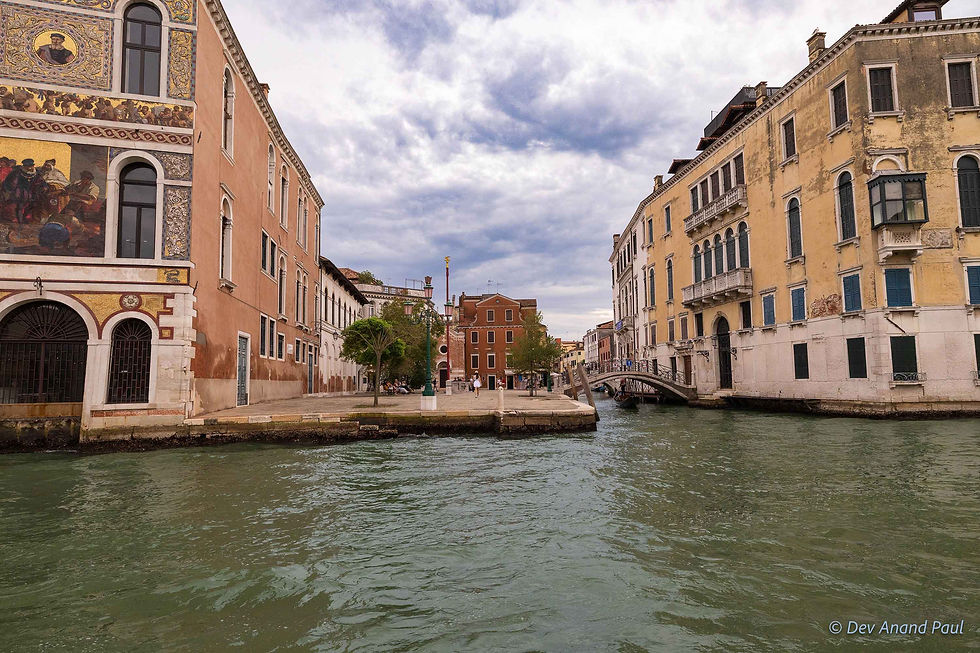
Venice’s irregular shape reflects this gradual process. Buildings and streets had to fit the available ground, and canals served as essential routes. The Grand Canal, the largest in Venice, became the principal waterway for transporting people and goods. Its banks were lined with palaces, warehouses, and public buildings dating from 13th to 18th centuries. Streets, bridges, and small squares connected neighbourhoods.


Venice’s Rise as a Maritime Republic


With Venice’s growing independence from the Byzantine Empire’s influence, its fortunes increasingly depended on maritime trade. Venice’s location on the Adriatic gave its merchants access to the eastern Mediterranean, in particular Constantinople, the Christian capital of the Byzantine Empire. Over time, privileges granted by the Byzantine emperors strengthened Venetian merchants’ position in eastern markets. This advantage allowed the republic to develop a maritime network linking Mediterranean ports with markets farther east and west.

Goods from Asia reached Europe through overland and maritime routes. Routes across Central Asia and through the Indian Ocean and Red Sea connected Asian markets with trading centres in the Byzantine and Islamic worlds. Often grouped under the term Silk Road, these routes were a network rather than a single road linking China directly to Europe. Silk, spices, and several other valuable goods passed through several commercial centres on the Silk Road before Venetian merchants carried them to western European markets.
Trade created Venice’s wealth, but slave trade was also a part of Venice’s commercial history. Venetian merchants bought and sold enslaved people from eastern Europe, the Balkans, and the Black Sea region, and forced them into domestic service or exploited as labourers.

As Venice sought economic and territorial advantages in the eastern Mediterranean, it was drawn into the Crusades, a series of religious wars in the 11th–13th centuries fought by European Christians against the Muslims in Palestine.
For the Fourth Crusade, Venice provided a fleet to carry the crusaders to Egypt, from where they planned to advance towards Jerusalem. However, disputes over payment and an offer from Alexios, a claimant to the Byzantine throne, diverted the expedition to Constantinople. After attacking Zara in 1202, the crusaders captured and sacked Constantinople in 1204.
Venice received a share of the spoils from this conquest and gained important territorial and trading advantages in former Byzantine territories, which strengthened Venice’s position in the eastern Mediterranean; however, it also deepened divisions between western Catholic Christians and the Greek Orthodox Christians of the Byzantine Empire.

Venice’s wealth, which came from long-distance trade, naval power, diplomatic privileges, territorial expansion, and exploitation of enslaved people, financed churches, palaces, public buildings, and paintings. The city’s architecture and art reflect the republic’s commercial ambitions and political power.


Islands of the Venetian Lagoon and Their Histories
The islands of the Venetian Lagoon developed around trade, religion, and specialized crafts. In what follows, I mention a few. Visiting them helped me understand how differently their communities had evolved.
Torcello: An Earliest Settlement of the Venetian Lagoon
Torcello, once a flourishing city, is now an island-village that is almost empty. Its main attraction is the Basilica of Santa Maria Assunta and its medieval Venetian-Byzantine mosaics. The marshes, reed beds, and waterways here offer a glimpse of the landscape in which Venice’s early communities developed.

Murano and Venetian Glass
Murano developed around glassmaking. Venice had established glass production centres by the late 10th century; however, in 1291, the government ordered the glass furnaces to be moved out of the city’s main urban area, largely to reduce fire risk.


This move led glassmaking workshops, along with craftspeople and their families, to concentrate on Murano. Over time, the island became closely associated with Venetian glass. Seeking to protect this commercial advantage, the Venetian Republic offered glass masters a string of incentives in order to safeguard the secrets of Murano glass-making techniques. It also imposed restrictions and harsh penalties on the craftspeople who tried to establish themselves elsewhere.

Burano: Fishing and Lacemaking
Burano is known for its brightly painted houses and the leaning bell tower of the Church of San Martino.
Although fishing sustained the island’s economy, lacemaking became another source of income from the 16th century, when Burano lace began to find buyers beyond the lagoon.

Over time, the lace industry changed in response to fashion and competition from other lacemaking centres. And in the 19th century, a lacemaking school was established to revive the craft. The island houses the Lace Museum, which documents lace development in the Venetian Lagoon till the present day and displays the work of lacemakers.

Mazzorbo: An Agricultural Island
Mazzorbo lies right next to Burano, connected by a wooden bridge. Unlike Burano, which is a bustling little island with busy streets, Mazzorbo is quieter, with scattered houses, fields, and vineyards.
This Venetian island was once an important settlement with churches, monasteries, and wealthy residences. The medieval church of Santa Caterina, with its old bell tower, recalls Mazzorbo’s earlier importance. As people and trade shifted elsewhere, many of its buildings fell into ruin or disappeared.

Agriculture remains part of the island’s identity. Dorona grape, a prized local variety traditionally grown in the lagoon, has been revived in recent decades and is used to produce golden white wine.

The contrast between Mazzorbo and the busier islands reflects their different histories. Murano became known for glassmaking; Burano, for lacemaking and fishing; Mazzorbo, on the other hand, retained much of its agricultural character.
San Michele: Venice’s Cemetery Island
San Michele lies between Venice and Murano. It is known as Venice’s cemetery island, as it houses the San Michele Cemetery, Venice’s main cemetery, the origins of which date to the Napoleonic period, when the authorities sought to move burials away from churches and residential areas.

In 1806, Napoleon’s administration designated the neighbouring island of San Cristoforo della Pace as the city cemetery. When the cemetery had to be expanded, the island nearby (San Michele) was chosen, and between 1835 and 1839, the channel between the two islands was filled up, joining them into a single one.
The Venetian Ghetto: Jewish Life and History in Venice
When I thought about Venice’s Jewish community, Shakespeare’s Merchant of Venice came to mind.
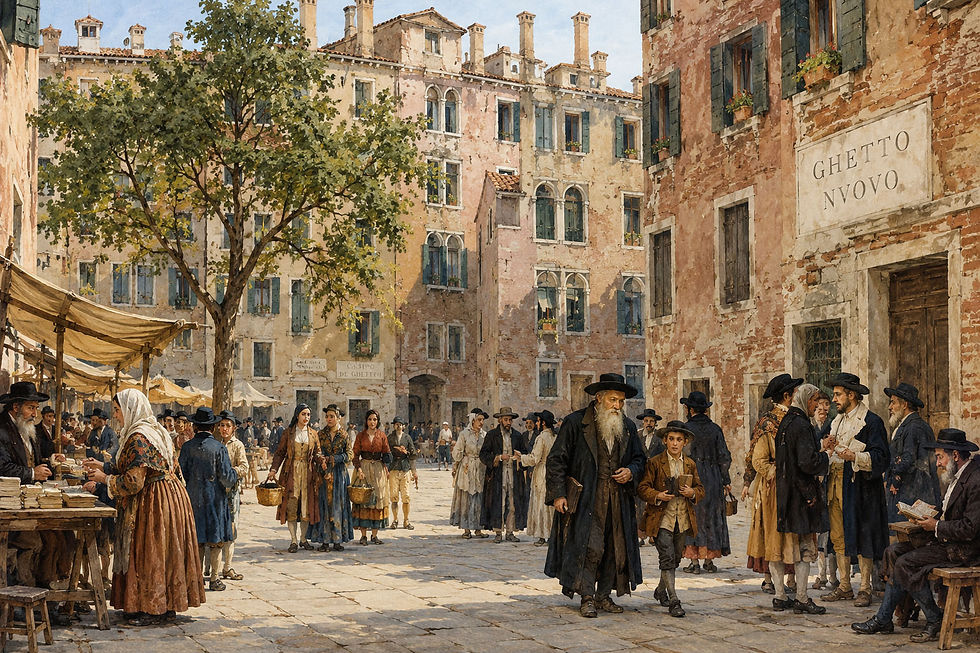
In 1516, the Venetian Republic issued a decree requiring Jews to live in a designated area, known as the Ghetto Nuovo. Its gates were closed at night, restricting residents’ movement. Yet the Jewish residents contributed to Venice’s economy as moneylenders, pawnbrokers, merchants, second-hand clothing and textile traders, and doctors. The Venetian term ghetto subsequently entered wider use.
Fall of the Venetian Republic
In 1797, Napoleon’s forces brought the Venetian Republic to an end. Doge Ludovico Manin removed his ducal cap and left the Doge’s Palace, marking the close of a government system that had endured for roughly 1100 years. Few states have maintained their identity for so many centuries.

The fall of the republic changed Venice’s political future. Today, the city faces a different challenge: tourism.
Venice Today: Overtourism and Heritage Conservation
Despite the unimaginable crowds, we were enjoying Venice, walking its streets and canals, visiting its historical buildings, and exploring the lagoon islands. During one of our walks, a graffiti caught our attention: ‘Get tourists out of Venice’.

The message made us think about the impact of tourism on the city and its residents. In recent years, tourist influx has surged to such an extent that tourists have outnumbered residents: The number of tourists increased from 9 million in 2015 to 34.5 million in 2025, according to a May 2026 article in El Pais, a Spanish daily newspaper. Although tourism supports hotels, restaurants, transport, museums, and shops, the heavy footfall puts pressure on public spaces and infrastructure. Homes are converted into short-term accommodations, and tourist-oriented businesses displace the shops and services residents rely on.


Venice is not just a historical city; it is a place where people live and work. The city’s challenge now is to protect its historical buildings while allowing its residents to continue living and working there. Whether the city succeeds in this endeavour remains to be seen.

Related posts
Amsterdam, the Netherlands: Exploring the City Without the Crowds
Giethoorn, the Netherlands: Beyond the Picture-Perfect Village
The Silk Road Explained: History, Trade Routes, and Cities of Uzbekistan
Registan Square, Samarkand: Understanding the Evolution of Islamic Architecture in Central Asia
Rishton Pottery: Uzbekistan's Ancient Blue Ceramics Along the Silk Road
Inside a Margilan Silk Workshop: How Traditional Ikat Silk Textile Is Made in Uzbekistan
Khiva, Uzbekistan: Itchan Kala, Silk Road Trade, and the City’s Hidden History
Bibi-Khanym Mosque, Samarkand: One of Islamic World’s Largest Mosques
Chilpik Dakhma, in Uzbekistan: Zoroastrian Towers of Silence and Parsi Migration to India
Tashkent Metro Stations: A Glimpse into Their Unique Underground Architecture
Aydarkul Lake, Uzbekistan: A Desert Lake Born from Soviet Irrigation
Samarkand Paper: A Visit to Konigil Meros Paper Mill in Uzbekistan
The Story of Indian Coins: 2600 Years of Wealth, Power, Trade, and Culture
Bhutan Postage Stamps: How a Small Kingdom Revolutionized Global Philately
The Battle of Colachel: How a South Indian Kingdom Defeated the Dutch
My Son Sanctuary: The Cham Temples of Vietnam and Their Indian Connection


Thank you Dev for sharing such a worthy stories...
Lovely Dev 🤩 You went to Morano?
Absolutely the best description and images accompanying the blog! enjoyed it. Best thing about your travelogue is that the description is simple and clear. Thanks for sharing Dev!!