
Rishton Pottery: Uzbekistan's Ancient Blue Ceramics Along the Silk Road
Updated: Jul 26
Discover Rishton, Uzbekistan’s best-known pottery town, where more than 2000-year-old pottery-making, especially blue-glazed ceramics made with traditional ishkor glaze, continues to shape everyday life.

After weeks exploring Uzbekistan’s Silk Road cities—Samarkand, Bukhara, and Khiva—we travelled east into the Fergana Valley, in particular the town Rishton, where people have been making pottery for more than 2000 years.
Excavations at Sohibi Hidoya Archaeological Site (an ancient settlement in Rishton) suggest pottery in Rishton dates to at least the 2nd–1st centuries BCE. Scholars trace ‘Rishton’ to the ancient Sogdian word rash, meaning ‘red earth’, a reference to the clay deposits that first attracted potters to this part of the valley. (Sogdian is an extinct Iranian language and the lingua franca used along the Silk Roads.)
Silk Road merchants carried Rishton’s pottery far beyond the Fergana Valley, distributing it across Central Asia. Many of the forms, decorative motifs, and glazing techniques uncovered during excavations are still used in workshops today.


We walked past several pottery workshops. Their façades display beautiful plates, and shopfront shelves showcase painted bowls, teapots, platters, and other artefacts. Ceramic tiles cover their gates and courtyard walls. Pottery was part of the streetscape.

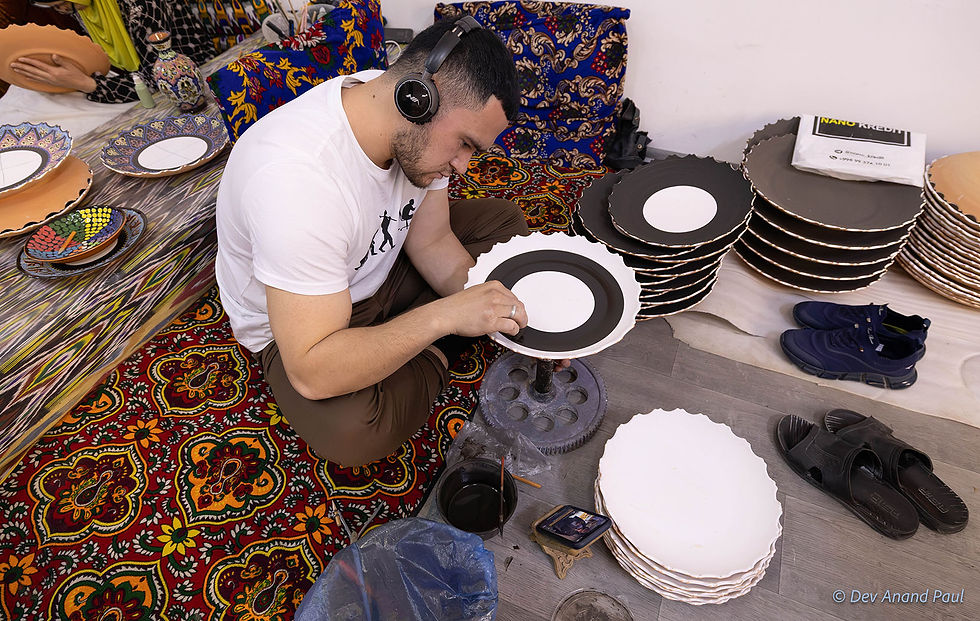
We visited Mingboshi Ceramics, a large workshop and museum. The owner’s teenage English-speaking son proudly and patiently showed us around. Pottery wheels spun steadily as craftspeople shaped clay into diverse objects. In another room, painters applied floral and geometric motifs by hand. Shelves were stacked with finished wares awaiting shipment across Uzbekistan and beyond.


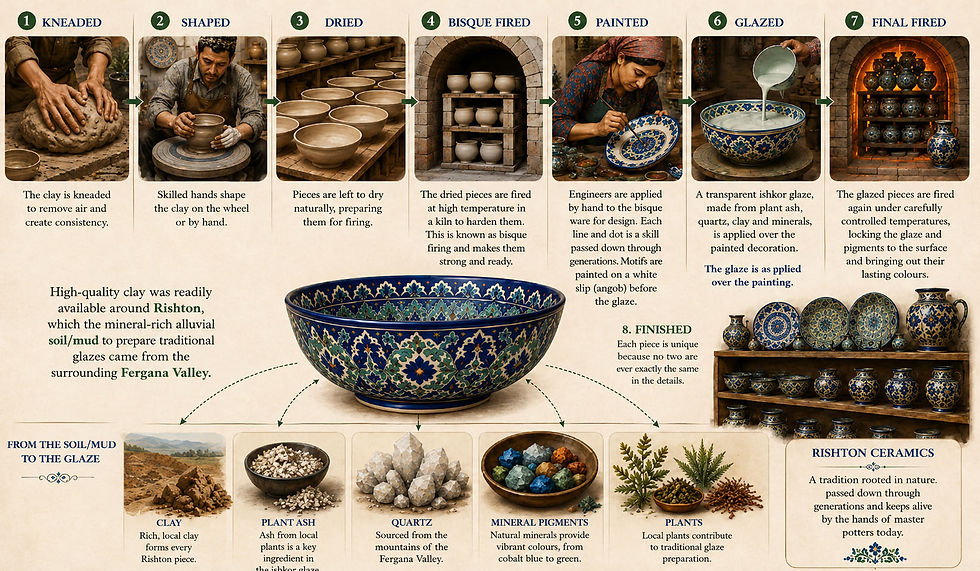
Each ceramic piece represented years of skill. Before a ware reaches the shelf, the clay is kneaded, shaped, dried, painted, glazed, and fired under carefully controlled temperatures. The high-quality clay used is readily available around Rishton, while the minerals and plants needed to prepare traditional glazes come from the surrounding Fergana Valley.
One detail inside Mingboshi kept drawing my attention: Cobalt blue, turquoise, and emerald green dominated the shelves. Bowls, plates, jars, and tiles all carried the same blue glaze, called ishkor.

Ishkor is prepared from plant ash, crushed quartz, clay, and mineral pigments. Objects are first coated with angob, a fine white clay slip (mixture of clay and water) that provides a smooth surface for decoration, then covered with the glaze and baked in the kiln.
No two firings produce the same result. Small changes in kiln temperature or glaze composition create subtle variations, producing shades that range from turquoise and aquamarine to emerald green and deep cobalt blue.

The same glazing techniques later appeared on the blue tiles covering Uzbekistan’s mosques, madrasas, and mausoleums. After spending days in Samarkand, Bukhara, and Khiva, I recognized that familiar palette inside the workshop. Read more in: Registan Square, Samarkand

The colours and glazing techniques had survived for centuries, passed on from one generation to the next. Master potters trained apprentices for many years through the ustoz-shogird tradition. (In Uzbek, ustoz-shogird means ‘master–teacher’; it is a cultural tradition, in Central Asia, of transferring knowledge and skills to posterity.) Working alongside their teachers, apprentices learned to judge clay, prepare glazes, regulate kiln temperatures, and recognize subtle changes during firing.


That system was disrupted during the Soviet period. Soviet industrial policy favoured standardized, factory-made ceramics over small family workshops, many of which were consequently absorbed into state-run factories. Also, synthetic enamels replaced traditional glazes, moulds replaced hand-shaping, and decorative patterns became increasingly uniform.
Moreover, factory wages drew workers away from family workshops. As fewer apprentices trained under master potters, the ustoz-shogird system weakened. And by the 1970s, only a handful of households in Rishton practised the older methods. As traditional pottery disappeared from everyday production, researchers and museum specialists began documenting the techniques still practised by the remaining master potters.

After Uzbekistan gained independence in 1991, state control over craft production eased and private workshops reopened. Potters revived their traditional methods and reinstated the ustoz-shogird apprenticeship, which had nearly disappeared.

Mingboshi embodied that revival. Pottery wheels turned once again, painters worked quietly at their benches, and apprentices learned the craft that had shaped Rishton for centuries.
Rishton Travel Guide
How to Reach Rishton
From Fergana: around 1 hour by road
From Kokand: around 45 minutes by road
From Margilan: around 1 hour by road
From Tashkent: around 4–5 hours by train or shared taxi
Shared taxis readily available
Things to Do in Rishton
Visit pottery workshops and ceramic studios
Watch artisans shape clay and hand-paint traditional motifs
Explore the International Ceramics Centre
Photograph workshops and artisans at work (with permission)
How Much Time Do You Need?
Half a day is enough to visit workshops and pottery showrooms.
Allow a full day if you plan to visit multiple workshops and museums or take a pottery class.
What to Buy in Rishton
Hand-painted decorative ceramic plates and other wall pieces
Traditional ceramic bowls, serving dishes, tea sets, and other artefacts
Decorative ceramic tiles inspired by historical Uzbek motifs
Facilities and Practical Information
Most workshops welcome visitors and demonstrate the pottery-making process.
Carry cash, as card payments are not always accepted.
English is limited outside major workshops.
Where to Stay in Rishton
Family-run guesthouses and homestays are available in and around Rishton.
Many stay in Fergana, Margilan, or Kokand and visit Rishton as a day trip.
Related posts:
The Silk Road Explained: History, Trade Routes, and Cities of Uzbekistan
Registan Square, Samarkand: Understanding the Evolution of Islamic Architecture in Central Asia
Bibi-Khanym Mosque, Samarkand: One of Islamic World’s Largest Mosques
Khiva, Uzbekistan: Itchan Kala, Silk Road Trade, and the City’s Hidden History
Chilpik Dakhma, in Uzbekistan: Zoroastrian Towers of Silence and Parsi Migration to India
Tashkent Metro Stations: A Glimpse into Their Unique Underground Architecture
Aydarkul Lake, Uzbekistan: A Desert Lake Born from Soviet Irrigation
The Story of Indian Coins: 2600 Years of Wealth, Power, Trade, and Culture
Bhutan Postage Stamps: How a Small Kingdom Revolutionized Global Philately
The Battle of Colachel: How a South Indian Kingdom Defeated the Dutch
My Son Sanctuary: The Cham Temples of Vietnam and Their Indian Connection
Armenian Church in Old Dhaka: History, Trade Networks, and the Legacy of Armanitola


Really interesting
Lovely Dev. Added this to my bucket list 🤩