
Padmanabhapuram Palace: India’s Largest Wooden Palace
Updated: Jul 30

Most palaces in India announce their power through scale and spectacle. Padmanabhapuram Palace, in Kanyakumari district, Tamil Nadu, is the largest wooden palace in India.

Crafted almost entirely from wood, it stands apart from the stone grandeur of Rajasthan palaces and the rigid symmetry of Mughal architecture. The palace features traditional courtyards, sloping tiled roofs, and shaded corridors—an architectural design shaped by climate, comfort, and everyday life needs in southern India. More than 400 years old, it spans across 6.5 acres and includes more than 15 independent structures, making it a palace complex.


From Venad to Travancore
To understand this palace, one must look back to the early 17th century CE, when southern India was a chessboard of shifting powers. The great Vijayanagara Empire had fallen, and small principalities were vying for independence. Amidst this uncertainty rose the kingdom of Travancore.
Long before Travancore’s glory, the region was known as Venad—a small feudal principality under the mighty Chera dynasty, the ancient rulers of Kerala. After the decline of the Cheras around the 12th century, Venad broke free and was governed by chieftains from the old royal line.

Their early capital was Kollam (Quilon), a port town bustling with Arab, Chinese, and Portuguese trade. As centuries passed, the Venad rulers sought safety away from the coast. In 1601, Iravi Varma Kulasekhara Perumal shifted the capital to Kalkulam, where the Padmanabhapuram Palace began to take shape.
The Rise of Marthanda Varma

Then came a ruler who would transform the Travancore kingdom: Anizham Thirunal Marthanda Varma (1706–1758). He shaped Travancore’s destiny through diplomacy, force, and shrewd political manoeuvring. In 1741, his forces defeated the Dutch East India Company at the Battle of Colachel, marking one of the first victories of an Asian power over a European colonial force.

Kingdom for a Deity
Marthanda Varma’s greatness lay not only in conquest. His rule was steeped in devotion; he dedicated his entire kingdom to Lord Padmanabha (Vishnu) in Thiruvananthapuram, declaring himself padmanabha dasa, servant of the lord—an act that shaped the very spirit of the Travancore kingdom.

Padmanabhapuram as a Seat of Power
During the reign of Marthanda Varma, the palace underwent a major transformation. Older structures were renovated and new buildings were added, all following traditional architectural principles.

The original mud fort walls surrounding the palace were rebuilt with granite stones.

Marthanda Varma also renamed the town Padmanabhapuram, meaning ‘the abode of Lord Padmanabha’. More than a royal residence, the palace was a military stronghold—a pada veedu—where nearly 10,000 soldiers once stood guard.
Decline and Revival
Empires, like seasons, change. In 1795, during the reign of Karthika Thirunal Rama Varma (Dharma Raja), the capital of Travancore was moved from Padmanabhapuram to Thiruvananthapuram, better suited for the kingdom’s expansion.

A few years later, during the reign of Balarama Varma (1798–1810), British troops captured Padmanabhapuram and Udayagiri. With administration firmly centred in Thiruvananthapuram, Padmanabhapuram slowly lost its importance and its former glory faded.

Yet tradition lingered; each year the Travancore royal family visited Padmanabhapuram for Navarathri celebrations, held here until 1839. After the festival venue was shifted to Thiruvananthapuram, the palace fell into neglect.

Nearly a century later, in 1934, Chithira Thirunal Balarama Varma, the last maharaja of Travancore, began the restoration of the palace with support from an Irish-Indian art critic J.H. Cousins and curator R. Vasudeva Poduval. And the palace was reopened as a museum in 1935.

After India’s linguistic reorganization, the palace—though located in Tamil Nadu—was placed under Kerala state government, ensuring continued protection of its historical and cultural links to Travancore.
A Walk Through the Palace
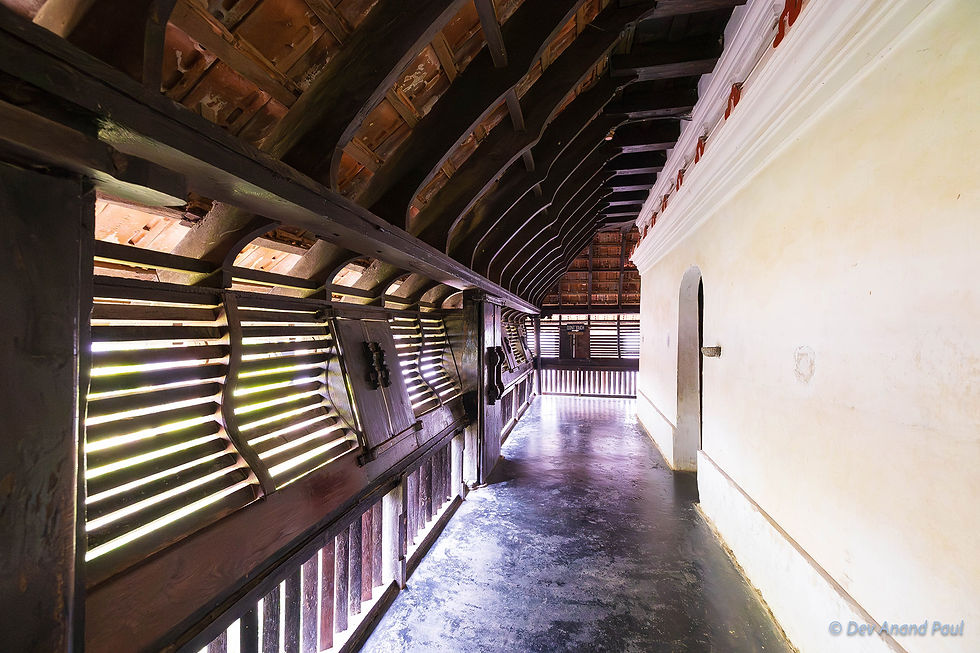
As I walked through the palace, soft light filtered through the wooden corridors and courtyards unfolded one after another. The beauty is subtle unlike the palaces in North India, and everything has a reason for its presence.

In this blog, I share a virtual walk through the palace’s halls, courtyards, and quiet corridors, guided by my photographs.

Mukhya Vathil (Entrance Gate)

The palace has two gates—the mukhya vathil (entrance gate) and a west-facing padippura (entrance gateway). The tall walls and heavy doors studded with metal spikes protected the palace from enemy attacks. The entrance gate leads into a spacious forecourt, where renowned wrestlers once entertained the king.

Poomukhamalika (Entrance Hall)
The walk begins at the Poomukhamalika, a two-storey structure, which opens with a poomukham, a pillared veranda where the royal family received officials and guests.

Looking up, you are captivated by the craftsmanship on the three stacked wooden gables (vertical triangular ends of a building)—carvings of gods, mythical creatures, and floral motifs. Two wooden brackets at the entrance depict a hunting scene with soldiers on horseback. The ceiling features 90 unique floral carvings.


Scattered around are objects of daily life, such as a granite cot and kutirakkaran vilakku (a brass hanging lamp featuring a horseback rider); onavillu (ceremonial bows with paintings of reclining Vishnu); and even a Chinese armchair, which hints at the palace’s global connections.


Mani Meda (Clock Tower)
On the northern side of the palace complex stands a Mani Meda, the clock tower, with a 200-year-old clock, which still runs on a simple weights-and-pulley system. The clock, marked with Roman numerals, is installed beneath a small gabled roof supported by wooden pillars. Centuries back, its chimes are said to have been carried for a radius of nearly 3 kilometres.

Natamalika (Upper Floor)
Above the palace entrance (padippura) runs a Natamalika (or upper storey), which links the northern and southern wings of the palace. It has a large exquisitely carved bay window that offers a panoramic view of the forecourt. On special occasions, royal women watched ceremonies and performances below through this window—present, observant, yet unseen.

Mantrashala (Audience Chamber)
Mantrashala is the king’s audience hall. It features decorative chairs for the king and his ministers under a wooden false ceiling with intricate carvings of lotus flowers and a carved wooden panel of Gajalakshmi (a form of the Hindu goddess Lakshmi), symbolizing prosperity.

What draws attention here is the floor—smooth and glossy black—believed to be made from a mix of lime, burnt coconut shells, egg white, tender coconut water, sand, and plant extracts.

Valiya Oottupura (Large Dining Hall)
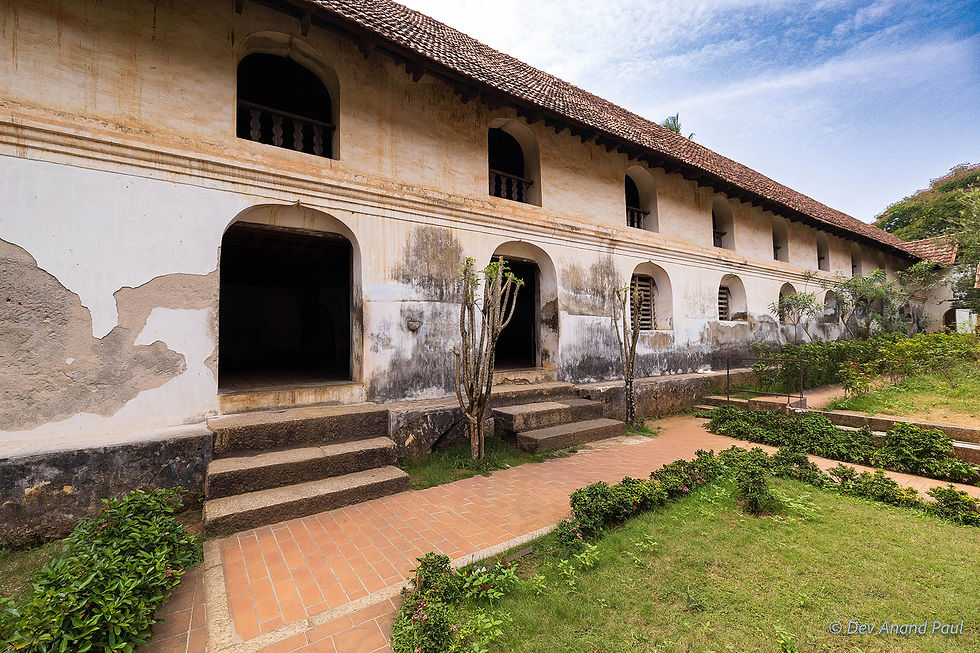
On the southern side of the complex is Valiya Oottupura, a massive refectory that once fed nearly 2000 people. The ground floor has stone columns supporting the ceiling, while the first floor has wooden pillars and massive beams. The floors are made of terracotta tiles. Stone tanks and large Chinese jars are found on the ground floor.


Thai Kottaram (the Mother Palace)
At the heart of the complex lies Thai Kottaram, the oldest part of the palace, built in the 16th century. Early records call it Valiya Neerazhikkara Koyikkal.

Its southern entrance leads into Ekantha Mandapam, featuring a ceiling with carved lotus motifs and an elaborately carved pillar at the centre.


The palace is built around a nalukettu (central courtyard) surrounded by nine rooms. A trapdoor on the western veranda leads to an underground chamber and escape tunnel connecting to another ancient palace miles away (Charode Palace, now demolished).

Uppirikka Malika (Multi-storeyed Mansion)
Uppirikka Malika, situated northwest of Thai Kottaram, has a pagoda-style roof and four floors. Each level served different functions:

• Ground floor: royal treasury
• First floor: the king’s bedroom
• Second floor: meditation hall (entry not permitted)
• Top floor: shrine for Lord Padmanabha (entry not permitted)

The king’s wooden bed, made from 64 different medicinal trees, likely came as a gift from the Dutch or Portuguese. The bedroom window overlooks a small yard where soldier recruits trained.


Ayudhappura (Armoury)
Ayudhappura, the palace armoury, is on the western side of the complex. It has two long, secure rooms on the first floor with small doors; it also has a watch tower. Its strategic location and easy access to key areas made it ideal for storing weapons.

Homappura (Ritual Complex)
Homappura is a single-storey, double-courtyard building used for sacred fire rituals. Central to these ceremonies is a water tank (homappura kulam), north of the Homappura.
To its east stands the Thevarakettu Saraswathi Temple, housing an idol of goddess Saraswathi believed to have been gifted by the 12th-century poet Kambar. The idol is still taken to Thiruvananthapuram annually for the Navarathri festival. Because of its religious importance, this area remains restricted.

Thekkaetheruvu Malika (the Southern Street Mansion)
Along the palace edge runs the Thekkaetheruvu Malika, a linear two-storey building overlooking the Thekkaetheruvu (Southern Street), an important processional street. The seat of administration, it housed palace offices and the cutcherry (local court).

Ambari Mukhappu
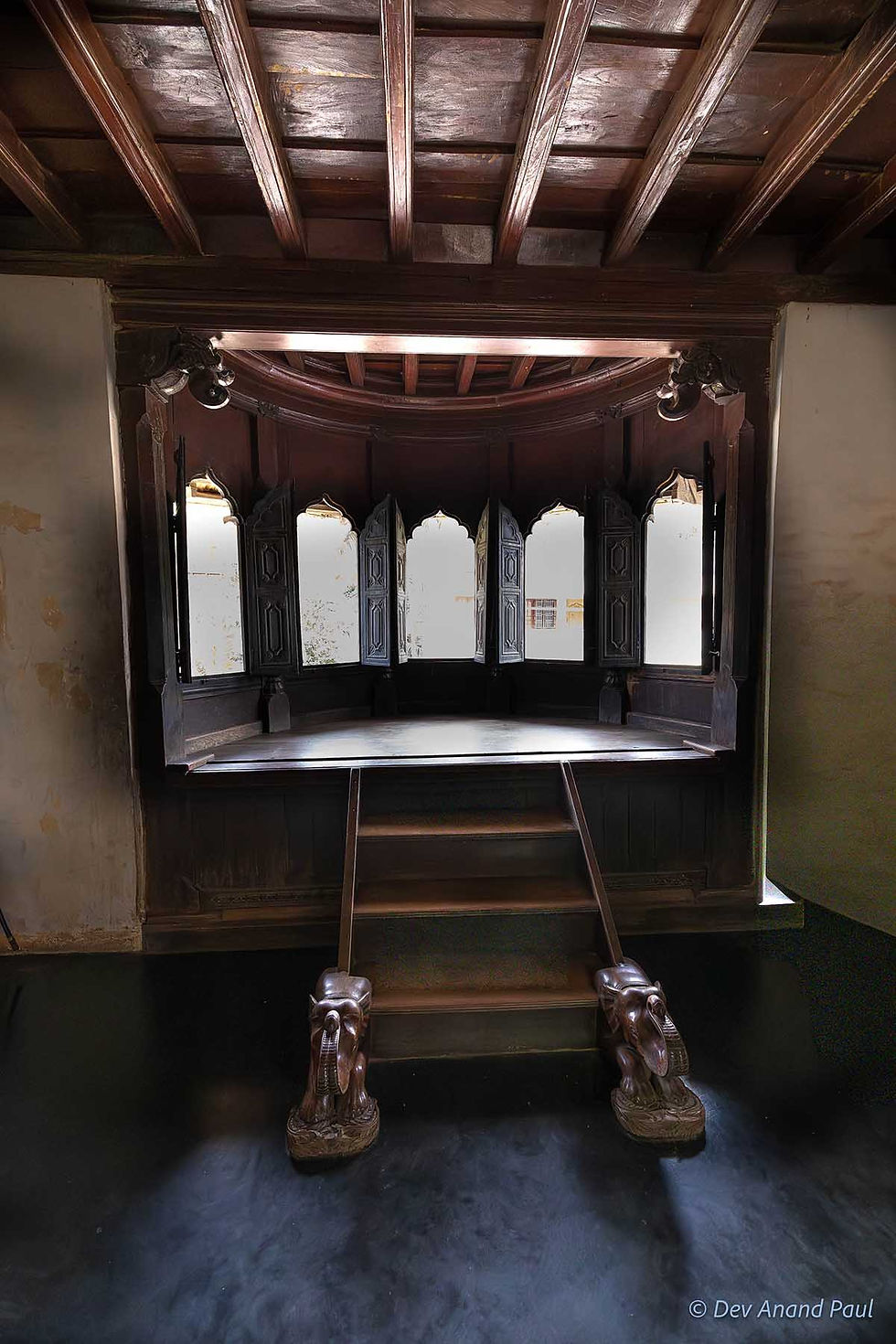
At the east end of the Thekkartheruvu Malika first floor lies an ornate bay window shaped like a royal ambari (carriage) mounted on an elephant. It has a conical roof. A short flight of steps with two carved elephant heads leads to a platform at the base of the window, from where the ruler addressed people and watched religious processions moving along the Thekkaetheruvu below.
Panthadikalam Malika (Pillared Hall Mansion)
Attached to the Thekkaetheruvu Malika, this double-storey building was also used for administration.

Navarathri Mandapam (Dancing Hall)
In the northwest corner stands the Navarathri Mandapam, a stone architecture built in classic Dravidian style.

Here we find monolithic pillars carved in Vijayanagara style with floral and geometric patterns, human dancing figures, and Vyali (mythical creature) figures at the capitals (top parts of the pillars).
Historically, this place was a cultural hub where southern Indian artists performed for the goddess Saraswathi.

Indra Vilasam (the Guest House)

Indra Vilasam blends colonial and local architectural styles, featuring a high ceiling, a wide staircase, balustrades, and pillared verandas with twin columns. Large windows with a view of a landscaped garden made it ideal for hosting Western dignitaries.

Thekkae Kottaram (Southern Palace)
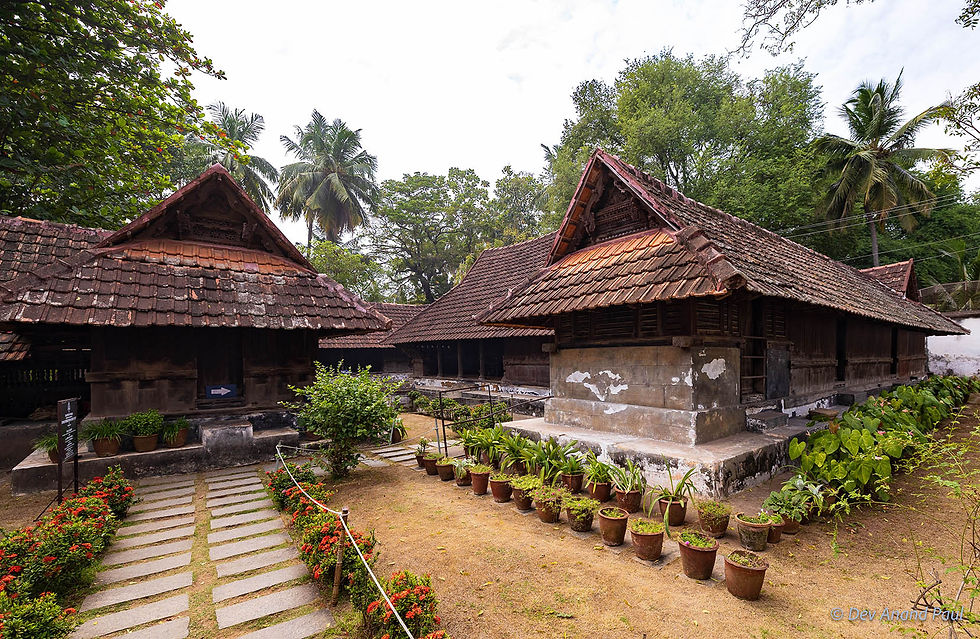
Thekkae Kottaram, also known as Nirappura, lies to the south of the Padmanabhapuram Palace. It is separated from the main palace complex by a public road. According to local narratives, however, it has always been an integral part of the palace. The mansion is known for its exquisite wooden craftsmanship.

Since 1993, the Thekkae Kottaram has been functioning as a heritage museum; traditional Kerala household objects are on display.

Lakshmi Vilasam (New Palace)
The walk ends at Lakshmi Vilasam, also called Putten Kottaram (New Palace). Built in the early 20th century, it was the last addition to the palace complex, and served as accommodation for officials at Kalkulam during the Travancore era. Its architecture includes colonial elements, distinguishing it from the older structures.

Is Padmanabhapuram Palace the Largest Surviving Wooden Palace in the World?
To understand what makes Padmanabhapuram Palace unique, it helps to compare it with other well-known wooden palaces around the world.
The Forbidden City in China (1420–1924) is vast and timber-rich, but its wooden halls sit on massive stone platforms and have been repeatedly rebuilt over centuries—a far cry from the original fabric.
Shuri Castle of Japan (1429–1879), once a fine wooden palace, was destroyed by war and fire multiple times; much of what stands today is reconstructed.
Padmanabhapuram Palace, by contrast, has extensive woodwork, which is still original. This rare combination of scale and integrity makes it probably the world’s largest surviving wooden palace.

Tips to Visit Padmanabhapuram Palace
Season: November to February is ideal; the weather is pleasant.
Located 60 km from Thiruvananthapuram (Trivandrum).
Timings: 9:00 a.m.–12:30 p.m., 2:00–4:30 p.m.; closed on Mondays and national holidays.
Entry fees:
Indians: adults ₹50, children (5–12 yr) ₹10
foreigners:adults ₹500, children ₹100
Photography charges:
mobile ₹10
DSLR camera ₹250
video (GoPro) ₹250
professional video ₹2000/hr
Interior spaces are dimly lit; a camera with good low-light capability helps.
Access to temple shrines and sacred chambers is restricted.
Allocate at least 2–3 hours to explore the edifice thoroughly.
Related posts:


simply superb and amazing. i never knew of its existence. hope to visit the palace someday
Superbly written…the images are stunning!
Super coverage Dev Anand Paul. Happy that I was able to visit this place way back in 1998. Thanks for the inputs too.
Wow a treasure trove of information