
Khiva, Uzbekistan: Itchan Kala, Silk Road Trade, and the City’s Hidden History
Updated: Jul 26
Khiva, in Uzbekistan, is one of the best-preserved ancient Silk Road cities in Central Asia. In this travel guide to Itchan Kala I explore the monuments, Silk Road trade routes, and slave trade legacy of Khiva, Uzbekistan’s walled city.

Itchan Kala is the ancient inner town in Khiva city (‘kala’ means ‘fortress’ in Uzbek). Walking into Itchan Kala, you feel as though you are stepping back into the era of the khanate. Narrow streets wind between mud-brick buildings, and heavy wooden doors open into homes built around private courtyards. Much of the city still appears much as it did centuries ago.


Itchan Kala: The Walled City of Khiva
Within Itchan Kala, the old city spans about 30 acres. Its outer fortifications rise more than 10 metres high and are 6 to 8 metres wide, with walkways on top. The walls run about 2.2 kilometres and have four main gates.


Inside, buildings are tightly packed, leaving little open space within the city walls. Amidst this dense urban layout stand nearly 50 madrasas, mosques, minarets, caravanserais, two palaces, numerous tombs, public squares, and market streets. Most of these major structures are arranged along a single street that runs across the city.

Written records trace Khiva back to the 5th and 6th centuries CE; however, most of the structures surviving today in Itchan Kala were built between the 17th and 19th centuries, during the height of the Khiva Khanate. Enclosed within the fortified walls, Itchan Kala served as the centre of power, religion, and learning. Beyond it lay Dishan Kala, the outer city of Khiva, home to traders, craftsmen, and workers along the caravan routes. Protected by walls and multiple gates, Dishan Kala formed an additional layer of defence; much of it, however, was dismantled during the Soviet period.

Top Monuments in Itchan Kala, Khiva
When you enter the western gate of Itchan Kala, the Kalta Minor stands straight ahead. Commissioned by Muhammad Amin Khan in the 1850s, it was intended to become the tallest minaret. Construction was halted, however, after the ruler was killed in battle in 1855, leaving the minaret unfinished, at 29 metres, instead of the planned 70 metres. The minaret’s 14.5-metre-broad base is covered with blue, turquoise, green, and white glazed tiles. Its unfinished form led to its name, Kalta Minor, meaning ‘short minaret’.


Next to Kalta Minor lies the Muhammad Amin Khan Madrasa, built between 1851 and 1854. Its façade is decorated with majolica—coloured glazed tiles—arranged in geometric patterns. Designed to accommodate more than 250 students, the building has a large courtyard with two levels of hujras, or student rooms. Students learned astronomy, geography, history, along with religious studies. After completing their education, many entered administrative service in the khanate.


During the Soviet period, religious education was restricted, which led to the conversion of the madrasa into a hotel—its student cells became guest rooms, and the mosque was repurposed as a restaurant.


Further ahead stands Kunya Ark, the earliest palace of the khans of Khiva. Built in the 17th century as a fortified residence inside the city, it had nearly everything required to administer the khanate—reception halls, a mint, mosques, stables, a prison, and private quarters. In its ceremonial hall (the Kurinish Khana) the khans received ambassadors, settled disputes, and handled matters of the state. The inside of this hall is decorated with carved ganch (a traditional Central Asian plaster made of gypsum and clay) panels featuring intricate floral patterns, and the roof is supported by wooden columns.


Tash Khauli Palace was built between 1830 and 1838 under Allakuli Khan. The name ‘Tash Khauli’ means ‘stone house’ in Uzbek. The palace includes reception halls, private living quarters, and a separate section housing the harem, with rooms arranged around courtyards. The interiors feature carved wooden pillars, painted ceilings, glazed tile panels, and intricate plasterwork. Historical accounts note that construction progressed slowly because of detailed craftsmanship, and that workers who missed deadlines reportedly faced harsh punishment.


Religious Architecture in Khiva’s Old City
The next monument inside Itchan Kala is the 10th–18th-century Juma Mosque, boasting 212 carved wooden columns, some of which date back several centuries, and a few are believed to have been reused from earlier buildings. The columns feature unique carvings and inscriptions from different periods. The mosque has no windows, and light enters only through openings in the ceiling, leaving the interior dimly lit. The place is no longer used for regular prayer.

Nearby stands the Islam Khoja Minaret, the tallest structure in Khiva, at about 57 metres. Built in the early 20th century, the minaret features the Khivan architectural style with its coloured glazed tile bands, but its height and slender form resemble the taller minarets of Bukhara. You can climb the narrow spiral staircase to the top—the view of the entire layout of Itchan Kala is spectacular.

Not far from the minaret lies the tomb of Pahlavan Mahmud (1247–1326), one of Khiva’s most revered spiritual figures. He was an Iranian poet, philosopher, wrestler, and craftsman, and is remembered today as the patron saint of Khiva. He is believed to have worked as a furrier, or leather craftsman, and was buried in his workshop after his death, as per his wish. Over time, his grave became an important pilgrimage site, and the modest tomb was gradually developed into one of the city’s most significant religious monuments.

Khiva and the Silk Road
For over a thousand years, Khiva served as a key transit stop on the northern routes of the Silk Road across Central Asia, which skirted the Caspian Sea, passed through the Karakum Desert, and linked Central Asia with Europe.

Traders halted here to prepare for the desert crossing to reach Persia. They bought food, water, and fodder, repaired saddles, harnesses, and carts, and stayed in caravanserais, which housed travellers, animals, and goods. Trade and caravan traffic were important sources of wealth for the city.

A caravan sculpture at the Itchan Kala entrance reflects this past. Bactrian camels, with their twin humps and ability to endure harsh climates, were ideal for those arduous journeys.

Slave Trade in Khiva: A Hidden History
In ancient and medieval societies, soldiers—and later, civilians as well—captured during wars were imprisoned and forced to work. As settlements expanded and the demand for labour increased, this gradually evolved into organized slavery. What began with war captives morphed into a trade in which non-locals, especially people of other religions or Islamic sects, were enslaved and sold.
Between the 17th and the 19th centuries, Khiva was a major slave trade centre in Central Asia. Turkmen, Kazakh, and Kyrgyz groups raided into Persian and Russian territories. Most of their captives were civilians—villagers from frontier settlements, and traders and pilgrims travelling across the desert.

They were brought to Khiva’s markets and sold. Their price depended on age, strength, skills, and origin. Once sold, they were assigned to work in irrigation projects, construction sites, or households. Children were allocated simple labour or domestic tasks. Young women and girls were often taken into elite households as servants or concubines. Nineteenth-century historical accounts suggest that tens of thousands of enslaved people passed through Khiva’s markets over time, many of whom were kept within the khanate as labourers. Large projects, including the Tash Khauli Palace, were built in part with enslaved labour. This system ended in 1873, when the Russian Empire conquered Khiva and abolished slavery.

Khiva Today: Inside Itchan Kala
Today, Itchan Kala, the fortified inner town of the ancient oasis city Khiva, is preserved as a UNESCO World Heritage Site. Properties in the old city are typically passed down through families. Even minor alterations to the buildings require government approval. Owing to such tight control, many residents have converted parts of their old homes into guesthouses, workshops, and souvenir shops, allowing them to earn a living while preserving the historical character of the buildings.

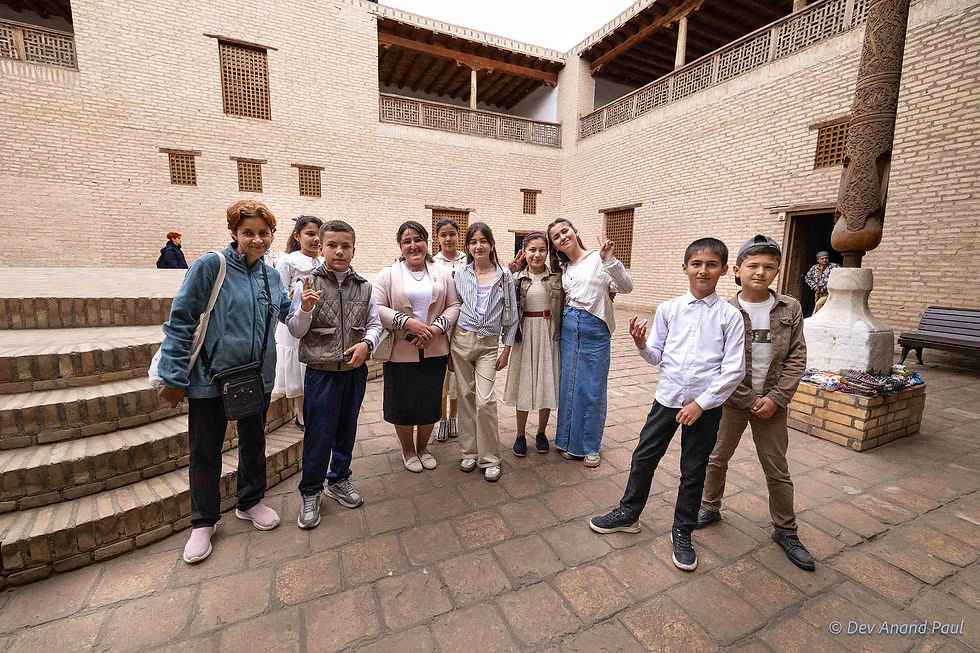
Itchan Kala—a good example of Islamic architecture of Central Asia—is a complex labyrinth of monuments and structures, so we engaged the guidance of SevinChoy Ozodova (+998 919948958), a school teacher and guide. Many thanks, Sevinch, for making the 5-hour tour of Itchan Kala fun and interesting.

Related posts:
The Silk Road Explained: History, Trade Routes, and Cities of Uzbekistan
Registan Square, Samarkand: Understanding the Evolution of Islamic Architecture in Central Asia
Bibi-Khanym Mosque, Samarkand: One of Islamic World’s Largest Mosques
Rishton Pottery: Uzbekistan's Ancient Blue Ceramics Along the Silk Road
Tashkent Metro Stations: A Glimpse into Their Unique Underground Architecture
Aydarkul Lake, Uzbekistan: A Desert Lake Born from Soviet Irrigation
The Story of Indian Coins: 2600 Years of Wealth, Power, Trade, and Culture
Bhutan Postage Stamps: How a Small Kingdom Revolutionized Global Philately
The Battle of Colachel: How a South Indian Kingdom Defeated the Dutch
My Son Sanctuary: The Cham Temples of Vietnam and Their Indian Connection
Armenian Church in Old Dhaka: History, Trade Networks, and the Legacy of Armanitola


Amazing details in your narration. Live the images…so much of pastel and earth colours giving a lovely contrast. So much history everywhere. Thanks for sharing