
The Story of Indian Coins: 2600 Years of Wealth, Power, Trade, and Culture
Updated: Jun 7

A coin is a small piece of metal stamped with a value and represents the authority and trust of a ruler or state.
Ancient coins are valuable historical evidence; they reflect the wealth of their time. The places from where they are unearthed help us trace ancient trade routes and political boundaries. Coins also hold the names of rulers, religious symbols, artistic styles, languages, and the culture of their period.
Recently, I spent a week with Dr. Tejus Naik at his Heritage Home Museum in Ahmedabad. A paediatric surgeon by profession, he has turned part of his home into a personal museum, housing over 8000 artefacts, ranging from million-year-old fossils and ancient coins to hookahs and vintage cameras, gramophones, typewriters, lamps, locks, and many more. Each object reflects a different time and way of life.

He has also written a book on the history of India and its coinage. Spanning 80 pages and divided into 11 chapters, it covers nearly 5000 years of Indian history clearly and concisely.
He walked me through his large numismatic collection, explaining the diverse symbols on the coins and the story and historical event behind each item. The visit inspired me to write this blog about the history of Indian coins.

1. The Origin of Money in Ancient India (3300–1300 BCE): From Barter to Early Exchange
Barter and Early Forms of Wealth in Ancient India
Before coins ancient India relied on barter systems; grains, cattle, beads, and crafted goods were exchanged as mediums of trade. Wealth was measured in tangible assets, such as livestock, metals, and tools.

Certain goods gained universal acceptance, laying the foundation for the idea of money and standardized exchange.
Indus Valley Civilization: First Steps Towards Currency (3300–1300 BCE)
In the Indus valley civilization, cities like Harappa, Mohenjo-daro, and Lothal were major trade centres. Archaeological excavations across different sites in the region have revealed similar standardized metal weights, including silver pieces.
Although not coins in the strict sense, they represent one of the earliest examples of portable and measurable wealth, dating back over 5000 years.

Vedic Period: Symbolic Money (1500–1000 BCE)
In the early Vedic period, wealth took on more symbolic forms. Cowrie shells, beads, and even cattle served as early forms of money, carrying social and economic value beyond simple barter.

Trade gradually moved from simple barter to a shared understanding of value. This shift prepared the ground for a system of currency.

The Birth of Coinage in India
The world’s first coins appeared around 600 BCE almost simultaneously in India, Greece, and China. In India, merchants began using stamped metal pieces.
These early ‘coins’ made transactions easier and helped overcome the limits of barter. Recognizing their value, local rulers soon began minting official coins, leading to organized and state-backed currency systems.
2. Early Indian Coinage (1500–300 BCE)
Gandhara, the Birth Place of India’s Earliest Coins
Gandhara, the region covering parts of present-day eastern Afghanistan and northern Pakistan, is widely regarded as the birthplace of India’s earliest coins. The coins from this region—bent bar (Shana) coins—often carried a distinctive six-petaled symbol from Gandhara, indicating authenticity and place of origin.
These coins marked a shift from symbolic wealth to minted currency.

Janapadas and Mahajanapadas: The Rise of Punch-Marked Coins
During the Vedic and post-Vedic periods, India witnessed the emergence of janapadas (small states) and mahajanapadas (larger states), ruled by kings or councils—the subcontinent’s first organized political units.
These states used punch-marked silver coins
made from thin silver sheets cut into pieces of uniform weight
stamped on one side only (uniface)
marked with up to five symbols using separate punches

Evolving Designs and Regional Symbols
As coinage spread across regions, local authorities began imprinting symbols reflecting regional identities. A 600 BCE punch-marked coin from Kuntala bears an enigmatic ‘wheel and pulley’ symbol.

A punch-marked coin of King Bimbisara of Magadha (5th century BCE) depicts a single-horned animal, likely a rhinoceros—evidence that rhinos once lived in the region of present-day Bihar.

Greek Influence: Alexander and Cultural Fusion
When Alexander the Great invaded northwestern India (326 BCE), coinage transformed into a tool of political symbolism. His coins combined Greek and Indian imageries: One coin shows Alexander wearing a lion’s head, evoking Hercules’s strength; another depicts him sporting an elephant headdress, symbolizing his conquest of India.

Taxila: Early Minting Techniques and Symbols
In Taxila, the capital of Gandhara and a major centre of learning and trade, copper coins were produced using die-struck and die-cast techniques (3rd–2nd century BCE).
Some of these coins featured
a three-arched hill or
a cross symbol
motifs unique to Taxila.

Ujjaini: The First Coins with Scripts (2nd Century BCE)
Around the 2nd century BCE, Ujjaini issued some of India’s earliest copper coins, featuring the Trimurti (the Hindu trinity) on one side and the inscription ‘Bhumi Mitra’ in Brahmi script on the other.

Satavahana Dynasty: Portraits on Indian Coins (2nd Century BCE–3rd Century CE)
The Satavahana dynasty (reigning over the Deccan region, now Andhra) was the first in India to have portraits of rulers on coins, marking a major shift towards personal kingship in Indian numismatics.
A coin of Vashishtiputra Satakarni (a Satavahana king) shows
the king’s portrait on one side
symbols of power, such as elephants or horses, on the other.

3. Foreign Dynasties and Their Coinage in Ancient India (2nd Century BCE–4th Century CE): Indo-Greek to Kushan
Indo-Greeks (180 BCE–10 CE): The Beginning of Cultural Fusion
About 150 years after Alexander’s campaign, Demetrius founded the Indo-Greek Empire in northwestern India. Its rulers were known as Indo-Greeks because they settled in India and blended Greek and Indian traditions.
Their coins introduced Hellenistic artistry, showing kings in lifelike, expressive portraits, combined with local Indian symbols.

Scythians (or Sakas, 150 BCE–400 CE): Horse Symbolism (1st Century BCE)
The Scythians, called Sakas in India, were equestrian nomadic people who came from Iran and Central Asia and ruled northwestern India around the 1st century BCE. They followed both Buddhism and Hinduism.
Their coins blended Central Asian and Indian styles and frequently featured horses, a symbol of their nomadic lifestyle and military strength.

Western Kshatrapas (35 BCE–405 CE): Genealogy in Coinage
The Western Kshatrapas introduced a highly advanced coinage system. Their coins featured the date of issue and the name of the ruling king and that of his father, which allowed historians to accurately reconstruct the dynasty’s genealogy.

Indo-Parthians (9 BCE–225 CE): A Period of Cultural Transition
The Parthians, from the Iranian plateau, ruled parts of northwestern India for nearly two centuries after the Indo-Greeks. Under their most famous ruler, Gondophares, coins showcased a blend of Greek artistic styles and eastern symbols, reflecting a cultural transition between the Greek, Iranian, and Indian worlds.

Kushans (30 BCE–375 CE): Buddhism and the Silk Route
The Kushans, nomads from Iran and Bactria (an ancient country in Central Asia), built a vast empire extending to Banaras. Under Emperor Kanishka, they promoted Mahayana Buddhism and fostered cultural exchange along the Silk Route. Their coins reflect this synthesis, showing the king in Central Asian attire on the obverse and Hindu deities or the Buddha on the reverse, blending Indian, Iranian, and Greek traditions.

Sasanians (230 BCE–365): Fire and Faith
The Sasanians, ancestors of the Parsis, came from Iran and expanded their influence up to the Indus River. Followers of Zoroastrianism, an ancient Iranian religion centred on truth, moral choice, and sacred fire, they were also influenced by Hinduism and Buddhism.
Their coins have a fire altar depicted on the reverse, a key symbol of Zoroastrian belief.

The Hunas (6th–8th century CE), from Central Asia, ruled parts of northern India after displacing the Sasanians. Their coins imitate Sasanian and Gupta styles: rulers in profile with elaborate headdresses and Brahmi or modified Greek inscriptions.
4. Gupta Dynasty and Early Medieval Indian Coinage (4th–12th Century CE)
Gupta Coinage: The Golden Age (4th–6th Century CE)
The Gupta dynasty, often seen as the Golden Age of India, produced some of the finest coins in ancient India.
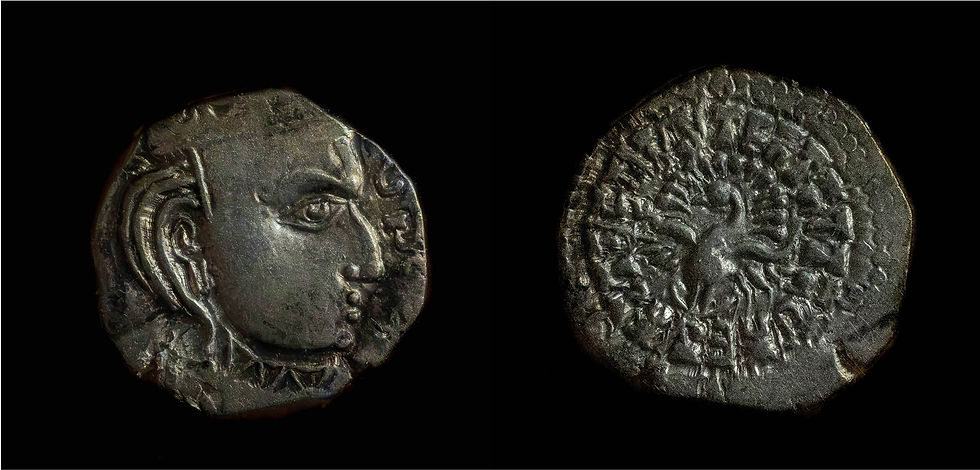
Their gold dinars, such as the Lion Slayer coin of Kumaragupta I, highlight royal strength and artistic skill. Silver and lead coins carried inscriptions and varied designs.

Transition to Regional Coinage (6th–12th Century CE)
From the 6th to the 12th century CE, power shifted from large empires to regional kingdoms, each issuing its own coins reflecting their local culture, religion, and authority. This period marks the move from early punch-marked coins and Satavahana portrait coins to more refined metal coinage with inscriptions, religious imagery, and symbolic designs.
Coinage of Northern Indian Kingdoms
In northern India, Emperor Harshavardhana’s gold coins depicted the king performing sacred rituals, often framed by floral designs. The Gurjar-Pratiharas, Palas, and Rashtrakutas (medieval Indian dynasties) issued coins depicting deities, royal symbols, and regional inscriptions. Notably, the Palas of Bengal produced elegant gold dinars featuring the Buddha seated on a lotus.

Coinage of Western and Deccan Kingdoms
In western India, Chavda and Maitraka rulers minted coins decorated with lions, suns, and crescent moons. Across the Deccan, Chalukya and Rashtrakuta dynasties brought out coins that often depicted kings on horseback, temples, and mythical creatures, highlighting royal authority and religious identity.

Coinage of Southern India
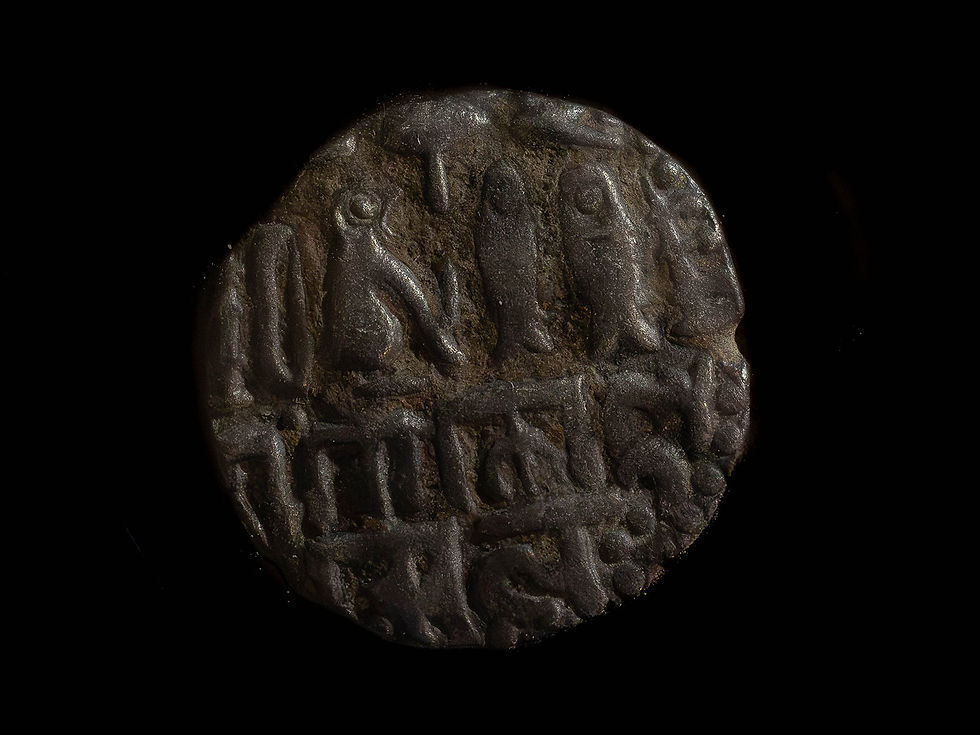
In the south, Pallava rulers issued small gold kasu coins engraved with tigers, lions, and temple motifs. The Pandyas used their distinctive fish symbol, often alongside royal portraits. The Cholas are renowned for their gold tiger coins, frequently featuring temple gopurams (massive towers), reflecting their temple-building tradition.
Central and Northwestern Indian Coinage
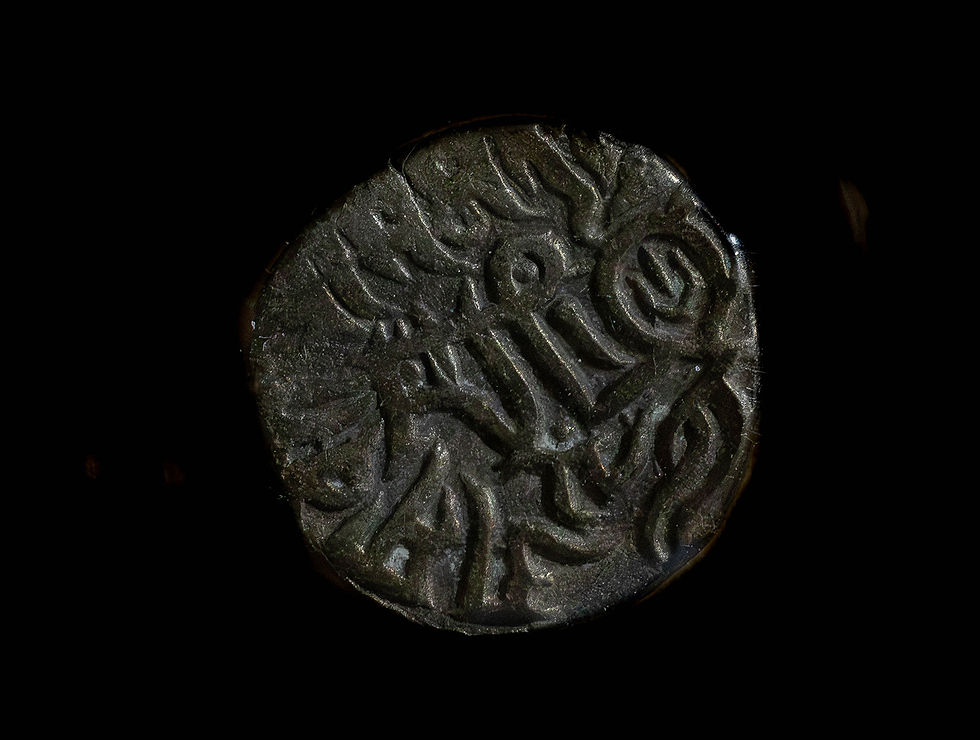
In central India, the Chandellas and Kakatiyas minted Gadyanas, large gold coins showing kings, deities, and temples.The Yadavas struck coins with cow and bull motifs, while the Chauhans of Rajasthan had horses, lions, and royal figures on their coins.
In Kashmir, the Karkota and Lohara dynasties used symbolic designs such as the lotus, sun, and crescent moon, continuing a strong regional influence.
5. Delhi Sultanate Coinage (13th–16th Century CE): From Muhammad Ghori to Sher Shah Suri
During the late medieval period, Indian coinage underwent major changes under the Delhi sultans. This era marked a transition from regional coin minting practices to a more centralized and standardized currency system.
Early Sultanate Coins: Muhammad Ghori and Cultural Blending
The transformation began with Muhammad Ghori (a Muslim ruler from the Ghor region, in present-day central Afghanistan), whose coins reflect a blend of Indian and Islamic traditions. Two important types survive:
coins bearing the names of both Ghori and the defeated Rajput king Prithviraj Chauhan
coins depicting Goddess Lakshmi and inscriptions in Devanagari script

These early coins show how Muslim rulers initially incorporated Indian symbols before fully adopting Islamic styles.
Iltutmish and the Standardization of Currency
Under Iltutmish, the greatest Delhi sultan, who expanded the Muslim empire in northern India (and moved the capital to Delhi, where he built the Qutb Minar), the Delhi Sultanate coinage took a definitive form. He standardized
the silver tanka (1 tola) and
the copper or billon jital (48 jitals = 1 tanka).

His coins carried the sultan’s name and title, the mint location and date, and sometimes the caliph’s name, a model followed by later Delhi sultans.
After the Delhi Sultanate period, several regional sultanates (including Kashmir, Malwa, Bahmani, Jaunpur, Bengal, Bijapur, Ahmednagar, Golconda) emerged and ruled for nearly three centuries, many lasting until Mughal expansion under Aurangzeb. Their coinage followed Iltutmish’s model in gold, silver, billon, and copper, with Arabic inscriptions written right to left.
Muhammad bin Tughluq’s Failed Currency Experiment
Later, Muhammad bin Tughluq introduced an ambitious monetary experiment by decreeing copper tankas equal in value to silver tankas. The policy failed because of widespread counterfeiting, forcing the state to withdraw the coins and abandon the system.

6. Mughal Coinage and the Birth of the Rupee (16th–18th Century CE)
Babur and the Early Mughal Coins
When Babur founded the Mughal Empire, his coins reflected strong Afghan and Central Asian design influences, echoing his origins. These early Mughal coins followed existing traditions; major monetary reforms were yet to happen.

Sher Shah Suri and the Birth of the Rupee
The true transformation of Indian coinage came under Emperor Sher Shah Suri. He introduced
the silver rupiya (11.5 grams, 1 tola)
the gold mohur
the copper dam.
This system set firm standards for weight, purity, and design, and became the foundation of the modern Indian rupee, influencing currency for centuries.

Akbar: Innovation and Artistic Freedom
Under Akbar (the greatest Mughal emperor of India), coins became a medium for creative expressions. Breaking orthodox norms, he issued coins featuring human and animal figures, including rare pieces depicting Ram and Sita.
His coinage blended religion, culture, and royal authority, making his reign one of the most innovative periods in Mughal numismatics.

Jahangir: The Peak of Mughal Coin Art
Akbar’s son Jahangir elevated Mughal coinage to its artistic peak. His coins featured
royal portraits
animals and birds
zodiac signs.

He even issued a 1000-mohur gold coin weighing about 12 kg (once held by the nizam of Hyderabad), the largest gold coin and the most valuable coin ever minted in India.

Shah Jahan and Aurangzeb: Beauty to Simplicity
Shah Jahan maintained the elegance of Mughal coinage but banned human and animal images (from Akbar and Jahangir period).

Under Aurangzeb, coin designs became simple and functional. Artistic elements were removed, inscriptions reduced to essentials, and mints focused on volume—the Ahmedabad mint alone produced around 166 tons of silver annually.

Decline of Mughal Coinage and Rise of Regional Currencies
After Aurangzeb’s death in 1707, the Mughal Empire fragmented into smaller states; centralized Mughal coinage declined, giving way to regional currencies.
Coins of Regional Powers After the Mughals
Across India, new rulers asserted authority through coinage:
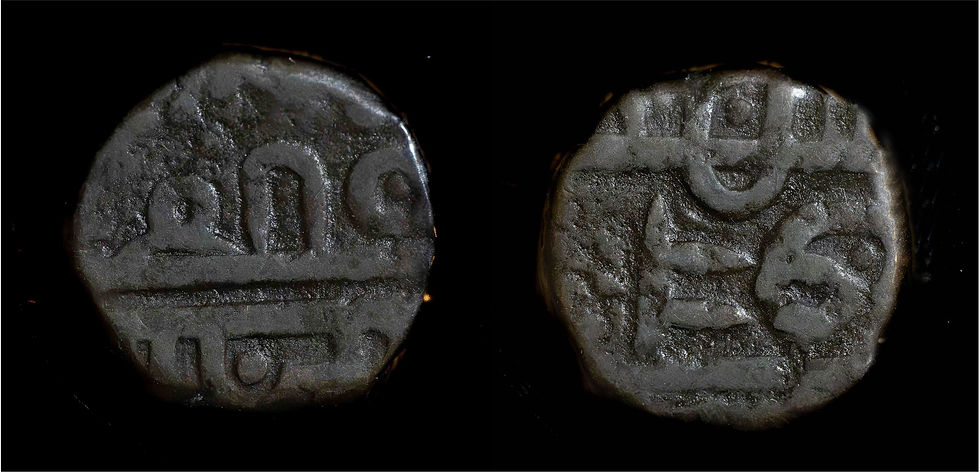
Marathas issued silver rupees and copper paise with Marathi inscriptions or religious symbols.
Nawabs of Bengal and Awadh minted silver rupees with elegant Persian inscriptions used widely in trade.
Rajput states struck coins featuring suns, lions, and lotus motifs, symbolizing local sovereignty.

7. British India Coinage (17th–20th Century CE): From Company Rule to Unified Currency
East India Company and India’s First British Coins
The story of British India coinage begins with the East India Company, which started minting coins in Madras in 1689 and Bombay in 1717. To gain acceptance among Indian traders, early company coins closely imitated Mughal designs, a practice officially permitted by Aurangzeb in 1692.

Presidency Coinage: Madras, Bombay, and Bengal
During the early phase of the British rule, the company governed India through three presidencies: Madras, Bombay, and Bengal. Each issued its own coins (ranging from copper pie and pice to silver rupees), rather than being centrally controlled, reflecting the fragmented political authority of early British India.


Standardization of British Indian Currency
A major shift occurred in 1835: India was brought under a unified British administration; the separate presidency issues were replaced by a standardized currency featuring the bust of the British monarch.

Despite the political change, the silver rupee retained its traditional weight of 1 tola, a standard originally set by Sher Shah Suri in 1540—a remarkable continuity lasting nearly 400 years.
Decline of Silver Coinage
It was only in 1939, during World War II, that the rupee’s metal content and size began to decline. Soon after, silver rupees were withdrawn from circulation, marking the end of a long chapter in India’s monetary history.

8. Coinage of Independent India (1950–Present): Republic to Digital Age
First Coins of Independent India
In 1950, independent India issued its first coins, proudly showcasing the Lion Capital of Ashoka (the head of a column erected by the Mauryan emperor Ashoka in the 3rd century BCE), now the national emblem. Marking a clear break from colonial rule, these coins reflected the identity of the new republic.

Initially, India continued using British-era denominations, such as pies and annas, ensuring transactional continuity during the early years of transition.

Decimalization of Indian Currency
The year 1957 saw a major reform: India adopted the decimal system, where 1 rupee equals 100 paise. This simplified calculations and aligned India’s currency system with global standards, making everyday transactions easier.

Materials and Designs of Modern Indian Coins
Unlike ancient gold and silver coins, post-independence Indian pieces were struck in aluminium, nickel, copper–nickel, or stainless steel.
Designs became simple and functional, often featuring
the national emblem
the Ashoka Chakra
wheat ears, oil rigs, and industrial symbols
motifs reflecting India’s focus on nation building and economic development.
Commemorative Coins: Preserving Memory in Metal
Independent India also releases commemorative coins to honour important leaders, cultural figures, and historic events. These pieces are not for everyday trade, just for remembrance.

Coins in the Digital Age
Today, coins coexist with cards, mobile payments, and QR codes. Although digital transactions dominate, coins remain part of daily life, especially for small purchases and informal exchanges.
From ancient punch-marked silver coins to modern stainless steel paise, India’s history continues to live—pressed into metal and passed from hand to hand.
Related posts:


truly enlightening article. i remember the copper anna and paisa and ring coins from my childhood.
I am just wondering how the value of every transaction have been improving era after era. In my childhood, saw some British era notes, played with 1 paise coins and these all are memories Really appreciate your effort for putting all the journey of coins in such a articulative way.. happy reading it
Well researched on the history of coins and an interesting read. Excellent work.
இந்த article ரொம்ப செம்மயா இருக்கு பா! இந்திய நாணயங்களோட 2600 வருட history-யை இப்படிச் சுவாரஸ்யமா சொல்லிருப்பது ரொம்ப rare. ஒவ்வொரு coin-க்கும் பின்னாடி இருக்கும் power, trade, culture எல்லாத்தையும் நன்றாக connect பண்ணிருக்கீங்க. பழைய punch-marked coins இருந்து modern காலம் வரைக்கும் evolution-ஐ clear-ஆ explain பண்ணிருக்கீங்க. படிக்கும்போது boring-ஆ இல்ல, flow super-ஆ இருக்கு. நம்ம நாட்டோட வரலாறு நாணயங்கள்ல எப்படி reflect ஆகுது என்பதைக் கச்சிதமா காட்டிருக்கீங்க. History-க்கு interest இல்லாதவங்களுக்கூட இதைப் படிச்சா interest வந்துரும். Overall-ஆ சொல்லணும்னா, informative-ம் engaging-மும் ஆன ஒரு mass article! 👌