
Samarkand Paper: A Visit to Konigil Meros Paper Mill in Uzbekistan
Visit Konigil Meros Paper Mill, near Samarkand, to learn about the revived ancient Silk Road tradition of papermaking, and watch the stages of the process.

Reading about the city’s history before travelling to Samarkand, we discovered that, besides its celebrated monuments, Samarkand was one of world’s great centres of papermaking; hence, we visited Konigil Meros Paper Mill, located on the outskirts of the city.

The Konigil Meros Paper Mill
As we walked in, a steady thud of wooden hammers echoed through the mill. A large wooden waterwheel, turned by water flowing through a canal fed by the Siab River, drove the wooden hammers that beat boiled strips of mulberry bark to pulp. The workshop smelled of wet bark, damp wood, and boiling fibre. Bundles of mulberry twigs leaned against one wall, and freshly made sheets rested on wooden boards to dry.


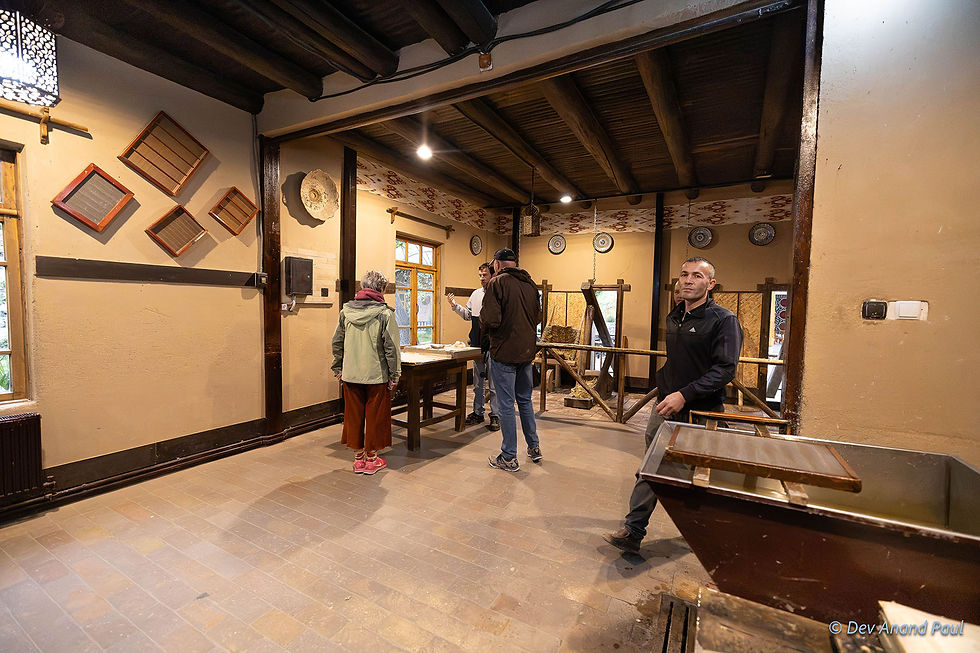
A craftsperson gave us a strip of mulberry bark to feel it. It felt surprisingly tough. He then pointed to a vat containing strips of bark soaking in water. In a few hours, he explained, those pieces would be transformed into a sheet of paper.


How Samarkand Became a Papermaking Centre
Paper was invented in China during the Han dynasty (from 202 BCE to 220 CE). Their techniques of papermaking remained closely guarded for centuries. According to the traditional account, the craft reached Samarkand after the Battle of Talas in 751 CE, when captured Chinese papermakers passed on their knowledge. This story is still debated by historians, but there is little doubt that by the 8th century, papermaking was firmly established in Samarkand.
The abundance of mulberry trees in the Zerafshan Valley provided the bark needed for papermaking, and merchants travelling along the Silk Road carried Samarkand paper to distant markets. Over time, local makers refined the techniques they had inherited, producing paper valued for its strength, smooth surface, and ability to absorb ink without bleeding. Each sheet was polished with a smooth stone or shell, giving Samarkand paper its famous burnished finish.
Paper gradually replaced older writing materials such as papyrus and parchment because of its lightness, ease of transport, and better affordability. The growing demand turned papermaking into one of Samarkand’s most important industries. Historical accounts have recorded about 42 paper workshops in and around the city.

Decline and Revival of Samarkand Paper
That prosperity, however, did not last. Cheaper factory-made paper imported from Russia gradually displaced the handmade product during the late 19th century. And within a few generations the craft had virtually disappeared. In 1995, brothers Zarif and Islam Mukhtarov began reviving it; they spent years researching historical sources and reconstructing the traditional papermaking process before establishing the Konigil Meros Paper Mill.
How Samarkand Paper Is Made
We watched as the softened bark was pounded with the wooden hammers until it became a fine wet pulp. The pulp was mixed into a vat of water. A worker then dipped into the vat a rectangular mould fitted with a fine screen (called a deckle), and lifted it, catching a thin layer of fibres. As the water drained away, a quick shake spread the fibres evenly to form a thin wet sheet, which was transferred to a flat surface. After stacking several such wet sheets, the water was pressed out, and the sheets were peeled away one by one and allowed to dry.


Once the sheets had dried, each one was placed on a polished marble slab and rubbed with a piece of bone until the sheet developed a smooth and glossy finish, for which Samarkand paper was highly prized.

The finished sheet was heavier than modern paper. We also noticed that it had a warm cream-yellow hue instead of the familiar bright white. The craftsperson explained that the paper was not chemically bleached, hence its natural colour. Keeping the fibres in their natural state, he said, made the paper remarkably durable. Today, this handmade paper is used to restore ancient manuscripts in Uzbekistan and abroad, and artists value it for calligraphy and miniature painting. A few visitors tried making their own sheets under the craftspersons’ guidance.


After the papermaking demonstration, we visited the workshop store. Its shelves were lined with notebooks, postcards, paintings, handbags, and other handcrafted paper products.
Having watched every stage of the papermaking process, we could better appreciate the scale of the revival. Reconstructing a craft that had disappeared more than a century back could not have been easy.
Related posts:
The Silk Road Explained: History, Trade Routes, and Cities of Uzbekistan
Rishton Pottery: Uzbekistan's Ancient Blue Ceramics Along the Silk Road
Inside a Margilan Silk Workshop: How Traditional Ikat Silk Textile Is Made in Uzbekistan
Registan Square, Samarkand: Understanding the Evolution of Islamic Architecture in Central Asia
Khiva, Uzbekistan: Itchan Kala, Silk Road Trade, and the City’s Hidden History
Bibi-Khanym Mosque, Samarkand: One of Islamic World’s Largest Mosques
Chilpik Dakhma, in Uzbekistan: Zoroastrian Towers of Silence and Parsi Migration to India
Tashkent Metro Stations: A Glimpse into Their Unique Underground Architecture
Aydarkul Lake, Uzbekistan: A Desert Lake Born from Soviet Irrigation
The Story of Indian Coins: 2600 Years of Wealth, Power, Trade, and Culture
Bhutan Postage Stamps: How a Small Kingdom Revolutionized Global Philately
The Battle of Colachel: How a South Indian Kingdom Defeated the Dutch
My Son Sanctuary: The Cham Temples of Vietnam and Their Indian Connection
Gandikota: The Grand Canyon of India


Comments