
Bhutan Postage Stamps: How a Small Kingdom Revolutionized Global Philately
Discover how Bhutan transformed postage stamps into global collectibles—from 3D stamps and talking ones to steel, CD, and NFT issues.

A small country with limited presence on the world stage often escapes global attention. Bhutan made itself visible to the world through its postage stamps.
In the 1960s, when most nations treated stamps as simple proofs of payment, Bhutan redefined them as objects of art, innovation, and diplomacy.
In this blog, I look at what sparked this creative revolution and how it ultimately reshaped Bhutan’s stamps.
The Origins of Bhutan’s Stamp Experiment
In the early 1960s, Bhutan approached the World Bank for a loan to build basic infrastructure—roads, hospitals, and an airfield. The request was rejected.
One of the advisers consulted during this process was Burt Kerr Todd, an American entrepreneur and close friend of the Bhutanese royal family. After the setback, Todd proposed an unconventional alternative: generating revenue through international sale of postage stamps.

The idea seemed modest compared with a large international loan. But Todd knew one thing for certain—stamp collectors worldwide were willing to pay for rarity, innovation, and beauty.
The Bhutan Stamp Agency: a New Vision
Although initially hesitant, the Bhutanese government eventually bought the idea on the premise that postage stamps would offer Bhutan global visibility and a political identity, far more valuable than revenue alone.
Subsequently, Todd created the Bhutan Stamp Agency, a private company based in the Bahamas, to design and market Bhutanese stamps internationally.

Early Failures and a Crucial Realization
The first stamp issues in 1962 with local Bhutanese imagery did not attract philatelists. Bhutan was little known internationally and had no access to established philatelic marketing channels; more important, the stamps lacked novelty.

Gradually, Bhutan realized that their stamps should be unique: something the collectors had never seen before.
The Breakthrough: World’s First 3D Postage Stamps
After years of experimentation, Bhutan made a breakthrough in 1967: the world’s first three-dimensional (3D) lenticular postage stamps (produced by a Japanese company). They featured astronauts and space missions, reflecting the height of the Space Age, and captured global attention.

Ironically, most Bhutanese had never seen a space launch then; Bhutan introduced television only in 1999, the last country in the world to do so.
In 1969, Bhutan joined the Universal Postal Union (UPU), gaining full international legitimacy of its stamps.
Epic Bhutan Stamps That Redefined Philately
Over the decades, Bhutan issued stamps that redefined what postage stamps could be.
Steel Foil Stamps
A 1969 issue featured a traditional Bhutanese painting showing women engaged in quotidian activities, such as collecting water. Printed on industrial steel foil, it became the world’s first steel stamp.

Gandhi, Mona Lisa, and Cultural Icons
In the early 1970s, Bhutan issued
a moulded plastic 3D stamp of Mahatma Gandhi (1972)
a self-adhesive stamp featuring Leonardo da Vinci’s Mona Lisa
a coin-shaped gold foil stamp commemorating King Jigme Dorji Wangchuck (1973)
These stamps featured images of global idols embossed on unconventional materials.


Talking Stamps: Postage Finds Voice
Perhaps Bhutan’s most famous innovation was the talking stamps, issued in 1972.

These are miniature vinyl records with adhesive backs for mailing; they also function as audio recordings and can be played on a standard turntable.
The recordings include Bhutanese
folk songs
national anthem
history in Dzongkha (national language of Bhutan) and English

Sold as first day covers (envelopes or postcards bearing a newly issued stamp cancelled with an inked stamping on the day of its issue), these stamps transformed postage into something that could not only be seen and touched but be heard as well.
Scented Stamps: Postage Finds Fragrance
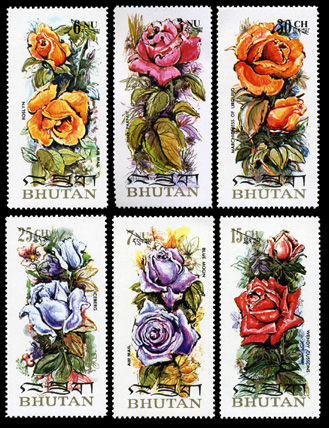
In 1973, Bhutan introduced another world first: scented postage stamps. The issue comprised six stamps, each depicting a different rose and emanating its natural fragrance through a specially developed long-lasting ink.
Cultural Themes and Global Pop Culture
Bhutan continued to surprise collectors with imaginative themes.
A 1976 airmail stamp (in a miniature sheet) featured a 3D ceremonial mask set against Bhutan’s mountains and dzongs (ancient fortresses-monasteries). A laminated prismatic surface creates the 3D effect.

In 1982, they issued a souvenir sheet celebrating Disney’s The Jungle Book.

A 1993 miniature sheet marked the Lunar Year of the Water Rooster, showing all 12 Chinese zodiac animals.

In 2008, a CD-ROM postage stamp was released to honour 100 years of monarchy, featuring portraits of Bhutan’s five kings and multimedia content, which comprised historical events and Bhutanese folktales.

Each issue showcased a judicious mixture of Bhutanese culture and global appeal.
Bhutan Post in the Digital Age: From Gold Foil to NFTs
In 2011, Bhutan issued a gold foil–embossed stamp to commemorate the royal wedding of King Jigme Khesar Namgyel Wangchuck and Jetsun Pema.

More recently, Bhutan became the first Asian postal operator to issue NFT postage stamps—digital collectibles issued by postal authorities and recorded on a blockchain (a shared digital ledger) as unique, non-replicable tokens. They function as digital or phygital versions of traditional stamps, allowing collectors to own and trade stamps, and verify their authenticity online.
These stamps, based on the 2014 stamp series ‘The 12 Deeds of Lord Buddha’ (20 stamps, in a miniature sheet format, depicting key life events of the Buddha), were launched in collaboration with Stampsdaq Estonia OÜ.

Bhutan's goal is to gradually digitize their entire philatelic heritage, offering collectors lifetime digital ownership.
Bhutan Post Now: Design and Personalization
Today, Bhutan Post designs stamps in-house and prints them abroad in small editions of around 10,000 copies. Themes are selected by a Bhutanese advisory committee, balancing national identity and international interest.
Most stamps are produced for collectors; a smaller number serve everyday postal use.
The Postal Museum in the capital city, Thimphu, is a major attraction. You can not only buy Bhutanese stamps but also create personalized ones for a small fee. In just 5–10 minutes, you receive a sheet of 12 or 20 valid stamps featuring your own photograph—often set against the backdrop of Tiger’s Nest, a famous monastery—which can be used to send postcards anywhere in the world.

Bhutan has proven that in global philately, imagination—not power—decides who is remembered.
Acknowledgement
I owe a lot to Dr. Tejus Naik of Ahmedabad, who generously shared his Bhutan stamp collection and offered valuable insights into these miniature works of art. A paediatric surgeon by profession, he has built a personal museum within his home, housing over 8000 artefacts—from million-year-old fossils and ancient and rare coins to hookahs to vintage cameras, gramophones, typewriters, lamps, and locks, and so many more interesting antique things.
Related posts:


brilliant writeup about a very clever idea to generate funds.