
Chilpik Dakhma, in Uzbekistan: Zoroastrian Towers of Silence and Parsi Migration to India
Updated: Aug 3
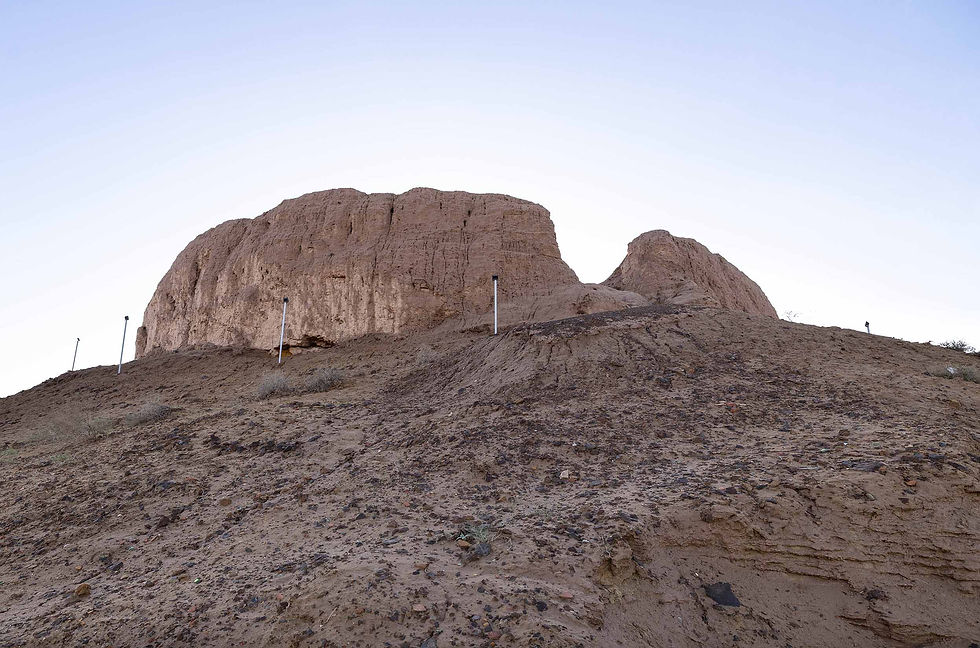
Chilpik Dakhma, in Uzbekistan, is one of the most unusual places to visit in Uzbekistan. Located between the cities Nukus and Khiva, this ancient tower of silence stands on an isolated hilltop overlooking desert plains. Its circular mud-brick structure was built for burials following the Zoroastrian principle that earth, fire, and water should remain unpolluted. Visiting Chilpik Dakhma gave me an insight about ancient Zoroastrian funerary practices in Central Asia and how the faith and burial traditions later travelled from Persia to the Indian subcontinent when Parsis migrated to India centuries back.

On a cold, windy morning we drove from Nukus to Khiva through an endless stretch of barren landscape—no villages or any visible signs of settlement along the road. About an hour into the drive, we spotted a circular mud-brick structure on a small hill.
Initially, its elevated position and thick outer walls gave an impression of a small fort. But as we approached the site, we realized it lacked the features unique to a fort. No watchtowers, narrow windows, or gates. It was a simple circular mud-brick enclosure with an open centre exposed to the sky. Known as Chilpik Dakhma, it was an ancient funerary site used by Zoroastrians.

We stopped at the site and climbed the steps leading to the structure. As we walked up the hill, our guide spoke about Zoroastrianism, one of the world’s oldest religions, which was practised across Central Asia and Persia long before the arrival of Christianity and Islam, possibly even before Buddhism.
I asked him about the purpose of that structure (dakhma) in the Zoroastrian funeral rites. He smiled and said that to understand that, I first needed to learn about the basic beliefs of the religion itself.
What Is Zoroastrianism
Zoroastrianism was founded by the Persian prophet Zarathustra, or Zoroaster. It believes in the worship of Ahura Mazda, the god of truth, wisdom, and order, who is in a cosmic struggle against Angra Mainyu, the force of evil and chaos. The faith’s religious laws, prayers, and rituals are proclaimed in its sacred texts known as the Avesta.


Tower of Silence: Zoroastrian Death Rituals
In Zoroastrianism, earth, water, and fire were considered sacred, and the last symbolized divine light and wisdom; hence, followers believed these elements should not be polluted by death and burial. This belief shaped Zoroastrian funerary practices. A corpse was considered impure, which meant burial contaminated the earth, cremation defiled fire, and disposal in rivers or lakes polluted the waters.

A dakhma (meaning ‘tower of silence’ in Avestan, an ancient Iranian language) is a circular stone or brick structure, about 8 metres high, built for Parsi funerary practices. Erected on hilltops, the dakhmas were designed such that the sacred elements were untouched by death. The bodies were carried to the top and laid out in the open, exposed to the elements and carrion birds. After the flesh was completely stripped off, the remaining bones were collected in a central pit within the dakhmas.
Zoroastrian Burial Practices in Samarkand
Although the underlying principle remained the same across Central Asia, the funerary practices varied across regions. At Afrasiab, a ruined site in the ancient city of Samarkand (in present-day Uzbekistan), archaeologists have uncovered decorated ossuaries (boxes for the bones of the dead), in which bones collected from the dakhmas were stored; whereas at Chilpik, the bones were left in a central pit within the dakhma itself.

Chilpik Dakhma History
Archaeologists believe Chilpik Dakhma was built between the 1st century BCE and the 1st century CE, when Zoroastrianism was widely practised in this part of the world.
The dakhma was used for several centuries, but its funerary role gradually declined between the 7th and 10th centuries, when Islam spread across Central Asia and Islamic burial practices replaced older Zoroastrian customs. The structure still stands as a reminder of an ancient funerary ritual.

Parsi Migration to India: From Persia to Gujarat
As we descended from Chilpik Dakhma, I remembered that the Parsi community in India has similar funerary practices rooted in Zoroastrian beliefs. Curious about the connection, I read more about the subject, and realized Chilpik Dakhma was not an isolated monument; rather, it was part of a much wider history linking Central Asia, Persia, and India.

As the Islamic rule expanded between the 7th and 10th centuries, Zoroastrianism gradually declined in the region. Many Zoroastrians converted to Islam; others migrated eastward to preserve their religious identity. These migrants settled on the west coast of India, mostly in Gujarat, and over time became known as the Parsis—derived from Pars (Fars), their historical Persian homeland.
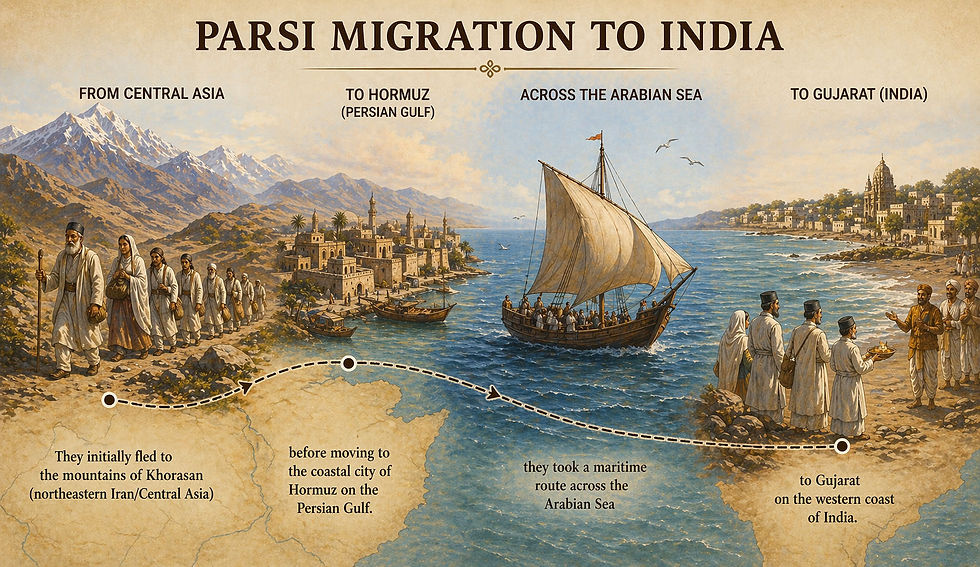
In India, the Parsis socially integrated with the society around them—learning regional languages, adopting local dress and food, and blending into local trade and public life, while preserving key Zoroastrian beliefs, including reverence for fire, rituals, and funerary traditions.
Rise of the Parsi Community in Bombay
The arrival of European trading powers, particularly the British, created new economic opportunities along India’s west coast. And the Parsis moved into port cities such as Bombay, where they participated in trade, shipping, administration, and, later, industry. Their literacy, commercial discipline, and ability to work across languages and cultures strengthened their position within the colonial economy, and by the 19th century, they had become one of the most influential communities in India.

Parsi Contributions to India: Industry, Science, and Defence
The influence of the Parsi community extended beyond business—philanthropy, education, science, and public institutions. They used their wealth generated through trade and industry to build hospitals, schools, libraries, research institutes, and public infrastructure.

Among the Parsis who shaped modern India, here are three prominent ones:
Jamsetji Tata laid the foundations of Indian industry.
Homi J. Bhabha—the architect of India’s nuclear program—shaped the country’s scientific and nuclear research institutions.
Sam Manekshaw led the Indian Army during the 1971 India–Pakistan War.
From Ruins to Living History
The fascinating part of Chilpik Dakhma is not the structure itself, but the history connected to it. What began as a visit to an ancient Zoroastrian funerary site gradually led me to the Parsis in India and the spread of people, beliefs, and traditions across Persia, Central Asia, and the Indian subcontinent.
The story of the Parsis helped me appreciate how communities that arrived in India over different periods were often able to preserve their faith and customs while gradually becoming part of the larger society. In that sense, Chilpik Dakhma no longer felt like an isolated ruin, but rather a surviving link to a much wider human history.
Related posts:
The Silk Road Explained: History, Trade Routes, and Cities of Uzbekistan
Registan Square, Samarkand: Understanding the Evolution of Islamic Architecture in Central Asia
Rishton Pottery: Uzbekistan's Ancient Blue Ceramics Along the Silk Road
Khiva, Uzbekistan: Itchan Kala, Silk Road Trade, and the City’s Hidden History
Bibi-Khanym Mosque, Samarkand: One of Islamic World’s Largest Mosques
Tashkent Metro Stations: A Glimpse into Their Unique Underground Architecture
Aydarkul Lake, Uzbekistan: A Desert Lake Born from Soviet Irrigation
The Story of Indian Coins: 2600 Years of Wealth, Power, Trade, and Culture
Bhutan Postage Stamps: How a Small Kingdom Revolutionized Global Philately
The Battle of Colachel: How a South Indian Kingdom Defeated the Dutch
My Son Sanctuary: The Cham Temples of Vietnam and Their Indian Connection
Armenian Church in Old Dhaka: History, Trade Networks, and the Legacy of Armanitola


I also wondered about Parsi community and their funeral rituals. Thanks for sharing your knowledge with such a long travel. Interesting to read and well described with quality images.
it’s quite interesting. I remember in Madhaya Pradesh I have seen this parsi funerary. what I have learnt that that the Parsis believe that even aftter death the body should not go to waste instead it should serve a purpose. Therefore, they place the deceased on top of a special funerary structure, known as a Tower of Silence, so that vultures and other carrion birds can consume it.Another thing I didn’t understand what is the capacity of that tower of silence, how long and how many bodies’ bones it can store, that also they might have planned. and why in olden days they kept the bones in the boxes as found by archaeologists, how did they collect? must be keep…