
Shah-i-Zinda, Samarkand: Uzbekistan’s Timurid Necropolis
Updated: Aug 3

Throughout my travels in Uzbekistan, I noticed meticulously maintained cemeteries. Families visit their loved ones’ graves and tend them, read the Quran, and introduce younger generations to those who came before them. The practice of remembering the dead was most evident at Shah-i-Zinda, Samarkand’s necropolis, where local families still pray in the centuries-old mausoleums. (Necropolis, in Greek, means 'city of the dead’, in archaeology, an extensive and elaborate burial place of an ancient city.)
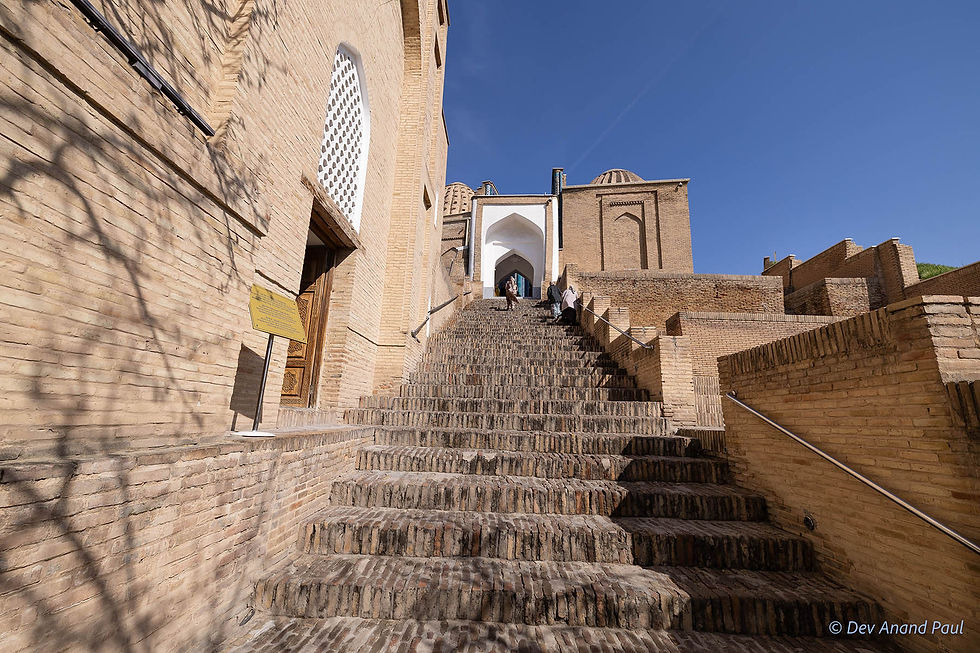
Shah-i-Zinda is situated on the northeastern edge of Samarkand beside the ancient settlement of Afrasiab. The name Shah-i-Zinda means ‘the living king’. It is traditionally believed that Qusam ibn Abbas, a cousin of the Prophet Muhammad credited with the early spread of Islam in Central Asia, is buried here.

Over centuries, his life and death have become the subject of legends. One of the best known recounts how enemies attacked him while he was praying, and rather than dying, he is said to have descended into a hidden realm beneath the earth, where he continues to exist in a spiritual state. This belief gave rise to the name Shah-i-Zinda.


The complex has a narrow avenue lined with mausoleums built over several centuries for members of Timur’s family and court, together forming the Shah-i-Zinda necropolis, a city of the dead within the living city of Samarkand.

Unlike Gur-e-Amir mausoleum, centred on Timur and his immediate family, Shah-i-Zinda reveals more of the Timurid world. The mausoleums here commemorate princes, princesses, Timur’s sisters, wives, nieces, military commanders, trusted officials, nobles, and religious figures.


Walking through Shah-i-Zinda was like following the evolution of Timurid architecture in stone and tile—a combination of glazed bricks, carved terracotta, painted majolica, mosaic faience, floral and geometric motifs, and calligraphy in elaborate compositions. Samarkand’s distinctive blue palette is featured throughout the complex, from turquoise domes to deep cobalt panels, the colours of which appear to change subtly depending on the angle of sunlight—a phenomenon called iridescence.


As I explored the mausoleum complex, I noticed a contrast between local visitors and tourists. Many tourists, excited by the grandeur, paused to photograph the intricate tilework, whereas local visitors walked quietly and stopped to pray, treating the site as a place of worship rather than simply a historical monument.

It is amazing how more than six centuries after many of its mausoleums were built, Shah-i-Zinda still remains a place of reverence.

Related posts:
Rishton Pottery: Uzbekistan's Ancient Blue Ceramics Along the Silk Road
The Silk Road Explained: History, Trade Routes, and Cities of Uzbekistan
Registan Square, Samarkand: Understanding the Evolution of Islamic Architecture in Central Asia
Bibi-Khanym Mosque, Samarkand: One of Islamic World’s Largest Mosques
Khiva, Uzbekistan: Itchan Kala, Silk Road Trade, and the City’s Hidden History
Chilpik Dakhma, in Uzbekistan: Zoroastrian Towers of Silence and Parsi Migration to India
Tashkent Metro Stations: A Glimpse into Their Unique Underground Architecture
Aydarkul Lake, Uzbekistan: A Desert Lake Born from Soviet Irrigation
The Story of Indian Coins: 2600 Years of Wealth, Power, Trade, and Culture
Bhutan Postage Stamps: How a Small Kingdom Revolutionized Global Philately
The Battle of Colachel: How a South Indian Kingdom Defeated the Dutch
My Son Sanctuary: The Cham Temples of Vietnam and Their Indian Connection
Armenian Church in Old Dhaka: History, Trade Networks, and the Legacy of Armanitola


Comments