
Registan Square, Samarkand: Understanding the Evolution of Islamic Architecture in Central Asia
Updated: Jul 26
Registan Square, an ensemble of three monumental madrasas, reveals the evolution of Islamic architecture, Timurid patronage, and the architectural history that shaped Samarkand over two centuries.

Certain monuments become familiar long before we see them in person—Registan is one such. I had seen photographs of the square countless times over the years, yet nothing had prepared me for the sheer scale of the complex.
Registan is not a single monument, but a colossal architectural ensemble of three enormous madrasas facing one another across a sprawling square—an architectural composition far larger than I had expected.

Registan is easier to understand once we study the long architectural history that shaped similar buildings across the Islamic world.
How Islamic Architecture Evolved Across Persia and Central Asia
Islamic architecture did not emerge in isolation. As Islamic rule expanded beyond Arabia, builders encountered Roman, Byzantine, and Persian forms that had already shaped monumental architectures across these regions. Over centuries, these influences gradually developed into a distinctly Islamic style.

Because Islamic tradition discouraged the depiction of living beings, especially within religious spaces, non-figural forms—geometry, floral ornaments, vegetal patterns, and Arabic calligraphy—became the dominant visual language across much of the Muslim world.

As Islamic civilization expanded, architecture increasingly centred around specific building types. Mosques served as places of prayer; madrasas functioned as learning institutions; Sufi lodges, or khanqahs, housed spiritual communities; and minarets were towers from which the faithful were called to pray. These buildings gradually developed distinct structural forms across different regions, shaped by local building practices.
Persia played a central role in this architectural evolution. Long before Islam arrived, Persian builders had established monumental traditions defined by symmetry, large ceremonial entrances, domed halls, and expansive courtyards. Many of these building forms later spread eastward into Central Asia, eventually shaping cities such as Samarkand and Bukhara (in present-day Uzbekistan).
Architectural Elements That Define Registan
One of the most important features to emerge from Persian influence was the pishtaq, a massive rectangular entrance portal framing the iwan (a vaulted hall or porch, the actual entrance), which became central to Islamic architecture. The pishtaq is usually at the centre of the façade. Over time, builders expanded this architectural form by including domes and surrounding courtyards with multiple iwans.
By the Timurid period, these building forms had reached immense refinement. Registan, for example, brings together pishtaqs, iwans, arcades, domes, muqarnas, and ceramic tilework, arranged with remarkable consistency across all three madrasas. (Muqarnas, or stalactite vaulting, is a three-dimensional geometric art form in Islamic architecture, used at the junctions of a building’s rectangular base and its vaulted ceiling to smoothen the transition.)
Registan can be better appreciated if you understand the architectural elements of the square and the design principles behind them. The following two illustrations explain some of the architectural features seen across the ensemble.


Samarkand: The Timurid Empire’s Great Imperial Capital
For centuries, the square served as the civic and commercial centre of Samarkand, where royal decrees were announced and state ceremonies held.
Merchants, scholars, soldiers, rulers, pilgrims, and travellers passed through this space as Samarkand emerged as a major Silk Road city linking Central Asia with Persia, India, and China. Unlike Khiva, which grew around caravan trade across the desert, or Bukhara, known for its religious institutions, Samarkand functioned as the imperial centre of the Timurid world.
Its position at the centre of the Silk Road trade routes brought wealth, but under Timur and his successors, Samarkand was no longer defined by commerce alone. Architecture, urban planning, and monumental construction transformed it into the political heart of an expanding empire. This wider historical importance was formally recognized in 2001, when UNESCO added Samarkand to the World Heritage List under the title Samarkand – Crossroads of Cultures.
The name Registan means ‘sandy place’. During Timur’s reign, this area contained a caravanserai, a mosque, and other public buildings. The present-day Registan developed after Timur’s lifetime. Between the 15th and 17th centuries, successive rulers replaced these structures with the three madrasas that now dominate the square.
Ulugh Beg Madrasa
Sher-Dor Madrasa
Tilya-Kori Madrasa

Although these three madrasas now appear as a unified architectural composition, each belongs to a different historical period.
Ulugh Beg Madrasa and the Scientific World of Timurid Samarkand
Ulugh Beg Madrasa, the oldest of Registan’s three Islamic institutions, was built between 1417 and 1420. It was commissioned by Ulugh Beg, Timur’s grandson, whose achievements in astronomy and mathematics placed him among the great scholars of the Timurid period.
Unlike many rulers remembered primarily for their conquests, Ulugh Beg was closely associated with scientific study. His work in astronomy led to the construction of the nearby Ulugh Beg Observatory, one of the most advanced astronomical centres of the 15th century.
The madrasa’s monumental pishtaq is covered with patterned ceramic inlay, calligraphic bands, and blue-and-turquoise tilework. Several motifs across the portal are interpreted by historians as representations of stars and constellations.


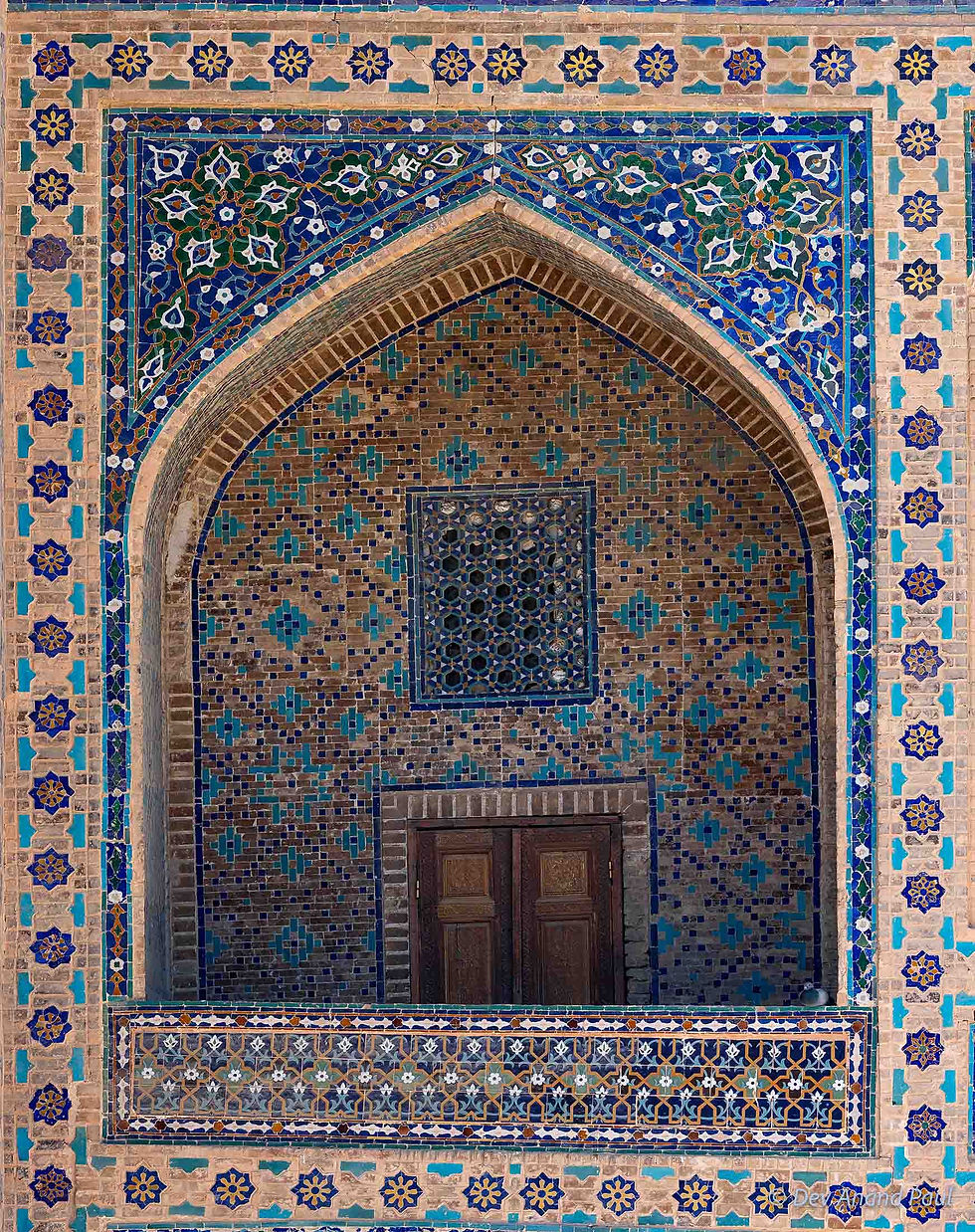

The edifice has an interior courtyard enclosed by arcades and student hujras (small residential chambers for students). Viewed from within, the building appears far more restrained in proportion than from the square.


Sher-Dor Madrasa and the Unusual Animal Imagery in Islamic Architecture
Sher-Dor Madrasa, built between 1619 and 1636, was deliberately designed, following the Kosh pattern, to mirror the dimensions, scale, and façade of Ulugh Beg Madrasa, creating the visual symmetry that defines the square. Kosh means ‘paired’ or ‘double’, and in Central Asia this technique involved building two architectural monuments facing each other, creating a symmetrical pair. But it contains imagery rarely seen in Islamic religious architecture. Above the entrance are large feline figures, often described as lions or tigers, pursuing deer beneath a sun with a human face. Such figural imagery is unusual in Sunni Islamic architecture and likely draws from older Persian artistic influences.


Besides these figures, the façade is covered with ceramic mosaic work, inscription bands, and glazed tilework, showing how earlier Timurid design traditions remained influential centuries later.


Tilya-Kori Madrasa and the Gold-Covered Mosque of Registan
Tilya-Kori Madrasa, the third, and final, monument completing the Registan Ensemble, was constructed from 1646 to 1660, on the northern side of the square. It was mainly a theological seminary. Unlike the other two Islamic schools, this structure has a mosque, the walls and dome of which have extensive gold decoration, hence the name Tilya-Kori, meaning ‘gilded’ in Persian.


Inside the mosque, extensive kundal work survives, a technique in which craftspersons first raised decorative patterns over plaster before applying paint and gold. In several sections, gold covers the surface completely that the underlying plaster is almost invisible.


Tilya-Kori Madrasa functioned both as an Islamic school and as Samarkand’s principal congregational mosque. Today, many former student cells serve as souvenir shops and small craft workshops.

This monumental edifice joins the two earlier madrasas on the northern side of the square, creating a symmetrical U-shaped architectural ensemble, and gives the square its unified appearance.
Registan: The Architectural Heart of Samarkand
After exploring the three madrasas, we returned to the centre of the square and spent some time taking pictures. Some visitors were sitting on benches, studying the buildings; others were moving slowly between the monuments.

These monuments were commissioned by different rulers centuries back, yet Registan still remains central to the city they helped shape.
Timur is often credited with saying:
‘If you want to know about us, look at our buildings.’
Looking at the Registan Ensemble, you realize those words need no explanation.
Registan Square Travel Guide
How to reach Registan Square
Registan square is located in the historical centre of Samarkand, Uzbekistan
From Samarkand airport: a 15–20 minutes by taxi
From Samarkand railway station: a 15 minute taxi ride
From central Samarkand: on foot or by a short taxi ride
From Tashkent: a 2-hour ride on the high-speed Afrosiyob train
Registan Square Opening Hours
The square is usually open daily from 8 a.m. to 8 p.m.
Opening hours may vary seasonally.
Entry tickets for Registan Square
Entry tickets are required (150,000 som per person).
Tickets can be bought at the main entrance.
Best time to visit Registan Square
Spring and autumn are generally the most comfortable times for visiting Samarkand.
Spring (April and May): pleasant weather
Autumn (September and October): cooler weather and clearer skies
Summer (June–August): very hot afternoons
Winter (December–February): fewer visitors but colder temperatures
Best time of the day to visit Registan Square
Early mornings have fewer tour groups.
Late afternoons often provide softer light for photography.
Many visitors return at night when the square is illuminated.
How much time to spend at Registan Square
Most visitors explore the complex for 2–3 hours.
Architecture, photography, and history enthusiasts may need half a day.
Dress code at Registan Square
Clothing covering shoulders and knees is generally appropriate.
Related posts:
The Silk Road Explained: History, Trade Routes, and Cities of Uzbekistan
Bibi-Khanym Mosque, Samarkand: One of Islamic World’s Largest Mosques
Rishton Pottery: Uzbekistan's Ancient Blue Ceramics Along the Silk Road
Khiva, Uzbekistan: Itchan Kala, Silk Road Trade, and the City’s Hidden History
Chilpik Dakhma, in Uzbekistan: Zoroastrian Towers of Silence and Parsi Migration to India
Tashkent Metro Stations: A Glimpse into Their Unique Underground Architecture
Aydarkul Lake, Uzbekistan: A Desert Lake Born from Soviet Irrigation
The Story of Indian Coins: 2600 Years of Wealth, Power, Trade, and Culture
Bhutan Postage Stamps: How a Small Kingdom Revolutionized Global Philately
The Battle of Colachel: How a South Indian Kingdom Defeated the Dutch
My Son Sanctuary: The Cham Temples of Vietnam and Their Indian Connection
Armenian Church in Old Dhaka: History, Trade Networks, and the Legacy of Armanitola


Comments