
Bukhara, Uzbekistan: The Silk Road’s Last Living City
Updated: Sep 7
Explore Bukhara, a historic Silk Road city in Uzbekistan, from the Ark Fortress and Po-i-Kalyan Complex to Lyab-i Hauz, the trading domes, and its ancient neighbourhoods.

Samarkand, Bukhara, and Khiva are often grouped as Uzbekistan’s great Silk Road cities, yet each tells a different story. Samarkand reflects the monumental ambitions of Timurid rulers, who made it an imperial capital. Khiva preserves a remarkably intact walled city, although much of its historical centre now functions as a protected heritage site.
Bukhara is neither an imperial showcase nor an open-air museum. It is a living city where history is part of everyday life. Residents still live in the old quarters, worshippers gather in centuries-old mosques, students study in historical madrasas, and merchants trade beneath the domes once used by Silk Road caravans. For centuries, Bukhara stood at one of the Silk Road’s key crossroads, linking China, India, Persia, Arabia, and the Eurasian steppes. Its trade wealth made the city one of Central Asia’s leading commercial and intellectual centres, drawing merchants and scholars.

Prosperity brought power. Successive dynasties fought for control of Bukhara and ruled from the Ark of Bukhara, a great fortress that dominated the city for centuries. That is where we began exploring the old city.
The Ark of Bukhara: The Fortress of Kings and Empires
The Ark, standing on an artificial mound nearly 16 metres high, rises above the surrounding streets. Archaeological evidence suggests the site had been occupied since at least the 5th century BC, making it one of the oldest continuously occupied parts of the city. Over centuries, successive rulers rebuilt the citadel on earlier foundations.

The open plains around Bukhara offered little protection from invading armies. Nomadic confederations, rival kingdoms, and expanding empires could cross vast distances with relative ease, forcing the rulers to govern from fortified citadels, and concentrate political authority and military defence behind massive walls.
The Ark was more than a fortress; it was the political centre of Bukhara—the palace, government offices, treasury, prison, and ceremonial spaces were all housed here. And the city prospered through trade, scholarship, and religion.
Having explored the Ark, we then walked into the old city. The next monument in our list belonged to a different chapter of Bukhara’s history.
Ismail Samani Mausoleum
Not far from the Ark stands the Ismail Samani Mausoleum, built during the 9th and 10th centuries under the Samanid dynasty. It is among the oldest surviving Islamic monuments in Uzbekistan and represents an early phase of Islamic architecture.

The building is restrained both in scale and design. Rather than the coloured tiles that are more common in Islamic architecture, bricks are arranged in different patterns, creating intricate geometric designs on the façade, an excellent example of how artisans could turn a simple building material into ornament.
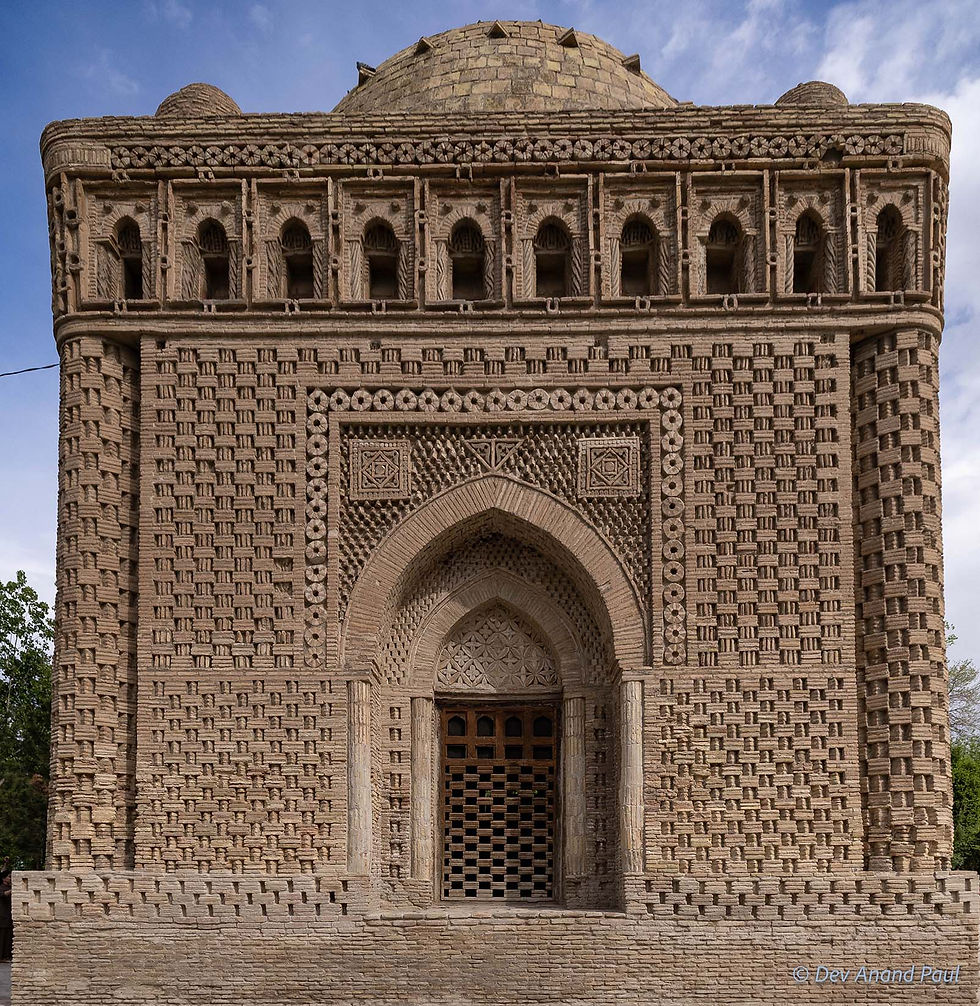
After the Samanid dynasty fell in 999 CE, the surrounding necropolis declined and many of its mausoleums disappeared, one of which—the Ismail Samini Mausoleum—was gradually covered by mud, sand, and debris, probably from flooding and erosion. By the early 20th century, it was almost completely buried; this helped protect it when the Mongols sacked Bukhara in 1220. The mausoleum preserves an early chapter of Islamic Bukhara, but the city’s story goes back even further.

Magok-i-Attari Mosque
The Magok-i-Attari Mosque stands on a site that predates Islam in Bukhara. Archaeological evidence suggests the site was associated with Zoroastrian worship. Over centuries, successive rebuilding raised the level of the surrounding streets, leaving older structures partially buried.

Like the Ismail Samani Mausoleum, Magok-i-Attari also survived the Mongol destruction that devastated much of medieval Bukhara.
If the Ark represented political authority, the monuments around Po-i-Kalyan, the principal religious complex of the old city, show the importance of religion in Bukhara. Rulers, scholars, and residents gathered around this square, making it a centre for religious and intellectual life.
Bolo Hauz Mosque
We stopped at the Bolo Hauz Mosque opposite the Ark. The mosque takes its name from a pond in front of it. In Persian, Bolo Hauz means ‘above the pool’. Before modern water systems came into existence, reservoirs like this supplied water and served as communal spaces.

The mosque served the rulers, who governed from the citadel, linking political authority with religious life. Its most distinctive feature is the entrance. Carved wooden columns support a painted timber ceiling decorated with floral and geometric motifs. The woodwork here stands apart in a city where brick dominates much of its monumental architecture. Despite invasions, a succession of rulers, and the Soviet rule, the edifice still serves as a place of worship.

From here, we continued towards Po-i-Kalyan.
Po-i-Kalyan
Few places better capture Bukhara’s historical importance than Po-i-Kalyan, an ensemble of three monuments: Kalon Minaret, Kalon Mosque, and Mir-i-Arab Madrasa. This square functioned as the city’s primary religious centre, where worship, education, and political authority existed side by side.
Kalon Minaret
The Kalon Minaret dominates the skyline, rising nearly 50 metres above the surrounding buildings. For merchants approaching Bukhara across the desert, it would have been the city’s first unmistakable landmark. Only when you approach the tower does its apparent simplicity (devoid of coloured tiles) give way to intricate bands of brickwork forming subtle geometric patterns.

The minaret is associated with one of the best-known chapters in Bukhara’s history: When Genghis Khan, the famous Mongolian conqueror, captured the city in 1220, he destroyed much of Bukhara. Local tradition says he admired the minaret so much that he spared it, though the story remains unverified.
Kalon Mosque
The Kalon Mosque is situated beside the minaret, and served as Bukhara’s main congregational mosque. Its vast courtyard, surrounded by arcades and arches, accommodated thousands of worshippers during Friday prayers and major religious festivals.
Mir-i-Arab Madrasa
The Mir-i-Arab Madrasa faces the mosque across the square and completes the ensemble. Built in the 16th century, it is known for its twin turquoise domes and richly decorated tiled façade. It takes its name from Sheikh Abdullah Yamani (also known as Mir-i-Arab), a scholar from Yemen, whose tomb lies within the complex.
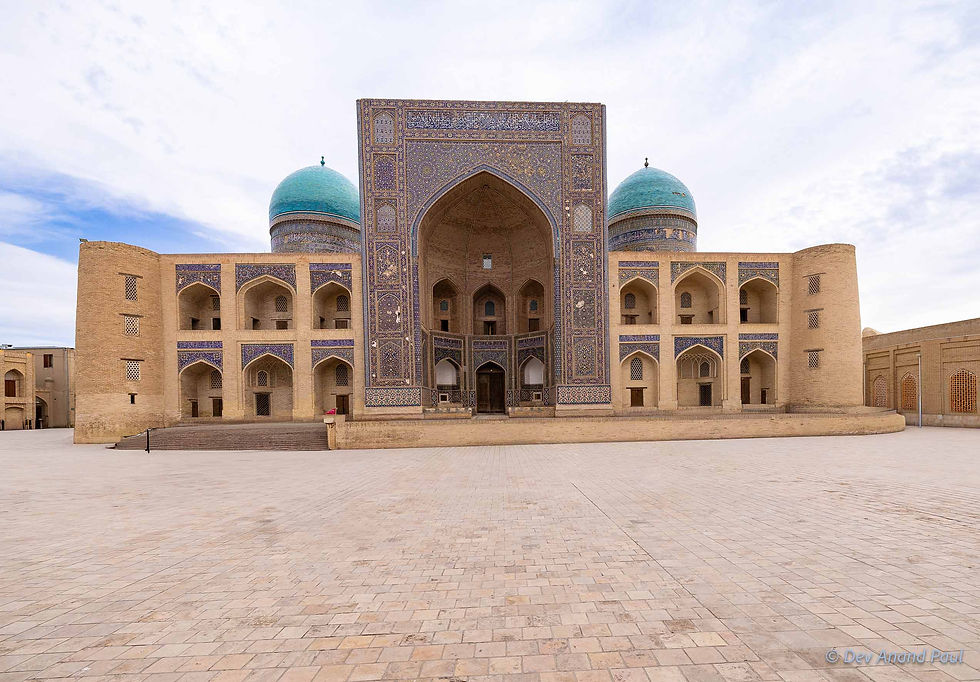
The madrasa’s history also reflects Bukhara’s changing political climate. Its activities were suspended in 1920, after the Bolsheviks captured the Bukhara Emirate. In 1945, it was reopened as a religious educational institution. Unlike the historical madrasas elsewhere in Uzbekistan, which now are monuments, Mir-i-Arab is a functioning madrasa; students study Islamic subjects within its historical walls.
A City of Scholars
Although religion shaped Bukhara’s identity, the city also became a major centre of learning. Students and scholars came here from across the Islamic world to learn subjects other than theology. Among the personalities associated with Bukhara were Muhammad al-Bukhari, whose collection of hadith remains one of the most authoritative works on Islam, and Avicenna, whose writings influenced medicine for centuries.
Ulugh Beg Madrasa
The intellectual culture continued into the 15th century with the construction of the Ulugh Beg Madrasa. Ulugh Beg, a Timurid ruler who, unlike many of his contemporaries, is remembered less for his military conquests and more for his works in mathematics and astronomy, built the Ulugh Beg Observatory in Samarkand around the 1420s. He also published an astronomical table and star catalogue in 1437, one of the most accurate catalogues in the pre-modern world used to compute time and the position of stars and planets. His interest in scholarship led him to establish educational institutions across his empire. And the madrasa in Bukhara reflected his interests. Students here studied mathematics, astronomy, literature, and philosophy, alongside religious instruction.
Lyab-i Hauz: The Social Heart of Bukhara
As we walked through the narrow streets of the old city after visiting the Po-i-Kalyan ensemble, the monumental buildings gave way to quieter neighbourhoods before the streets opened onto the Lyab-i Hauz, a large square built around a huge pool (hauz).

The pool once stood at the centre of a busy district surrounded by madrasas, markets, and neighbourhood streets. Merchants, students, and residents gathered around it. Unlike the monuments we had visited earlier, the Lyab-i Hauz was a place for everyday life, not ceremony.
Soviet modernization removed most of Bukhara’s historical reservoirs, ending an urban water system that had shaped the city. The Lyab-i Hauz is one of the few that have survived.

People still gather beneath the old mulberry trees around the pool. Cafés line the water’s edges, children play around the pool, and residents sit by the water.

Nadir Divan-Begi Complex
The Lyab-i Hauz is surrounded by three major edifices: two madrasas and a khanqah. These served religious, educational, and commercial functions.
Nadir Divan-Begi Khanqah
The Nadir Divan-Begi Khanqah is a Sufi lodging house where Sufi mystics gathered for prayer, study, and spiritual retreat.

Nadir Divan-Begi Madrasa
The Nadir Divan-Begi Madrasa was commissioned by Nadir Divan-Begi, an influential statesman during the reign of Imam Quli Khan.

According to local tradition, the construction of this building began as a caravanserai for merchants travelling the Silk Road. When Imam Quli Khan visited the site before completion, he mistook it for a madrasa and praised Divan-Begi for building a new centre for learning. Rather than correct the ruler, he had the building completed as a madrasa. Whether factual or embellished later, the story reflects the importance attached to scholarship in Bukhara.

This madrasa is unusual for another reason: Its façade has pictures of birds and mythical creatures, imageries rarely found on Islamic architecture.
Kukeldash Madrasa
The Kukeldash Madrasa was among the largest educational institutions in 16th-century Bukhara. More than 160 student cells surrounded its courtyard, accommodating over 320 students.
The Jewish Quarter of Bukhara
Beyond the Lyab-i Hauz, the streets gradually become quieter and lead into another chapter of Bukhara’s history.
For centuries, Jewish communities lived in this part of the city as merchants, artisans, and traders, preserving their unique religious traditions while contributing to Bukhara’s commerce. The neighbourhood became one of the oldest and most important Jewish settlements in Central Asia.

During the late Soviet period and after the collapse of the Soviet Union, much of Bukhara’s Jewish population emigrated to Israel and the United States, leaving behind synagogues, courtyard houses, and quiet residential lanes. Although much of the community has now left the town, the neighbourhood stands as a reminder that Bukhara’s history was shaped by many cultures and faiths.
Trading Domes
From the religious quarter, we wandered into Bukhara’s covered trading domes. Merchants arriving along the Silk Road bought and sold silk, carpets, jewellery, spices, and metal articles beneath these vaulted markets. Rather than a single bazaar, Bukhara had specialized trading domes where different crafts and commodities were concentrated in particular locations.

Tourism has replaced the caravan trade, but shops still occupy the historical buildings, craftspeople continue their traditional trades, and visitors navigate through the same spaces once used by merchants travelling between China, Persia, India, and the Mediterranean.
Unlike many historical cities where commerce has moved elsewhere, Bukhara’s old markets still remain part of everyday life.

The caravans are gone, so are the dynasties that ruled from the Ark and the merchants who once arrived from across Asia. Yet the city was never turned into a monument for visitors. Its historical centre is now part of the city itself.
Bukhara Travel Guide
UNESCO status: Historical Centre of Bukhara (1993)
Famous for: Silk Road history, Islamic architecture, madrasas, trading domes, and historical neighbourhoods
Recommended duration of stay: 2 days
Getting around: best explored on foot
How to reach Bukhara
By train: High-speed Afrosiyob trains connect Bukhara with Tashkent and Samarkand.
By air: Daily flights operate from Tashkent.
By road: Bukhara is about 270 km west of Samarkand.
Best Time to Visit Bukhara
Spring: April and May
Autumn: September and October
Summers can be extremely hot
Related posts:
The Silk Road Explained: History, Trade Routes, and Cities of Uzbekistan
Registan Square, Samarkand: Understanding the Evolution of Islamic Architecture in Central Asia
Rishton Pottery: Uzbekistan's Ancient Blue Ceramics Along the Silk Road
Inside a Margilan Silk Workshop: How Traditional Ikat Silk Textile Is Made in Uzbekistan
Khiva, Uzbekistan: Itchan Kala, Silk Road Trade, and the City’s Hidden History
Bibi-Khanym Mosque, Samarkand: One of Islamic World’s Largest Mosques
Chilpik Dakhma, in Uzbekistan: Zoroastrian Towers of Silence and Parsi Migration to India
Tashkent Metro Stations: A Glimpse into Their Unique Underground Architecture
Aydarkul Lake, Uzbekistan: A Desert Lake Born from Soviet Irrigation
Samarkand Paper: A Visit to Konigil Meros Paper Mill in Uzbekistan
The Story of Indian Coins: 2600 Years of Wealth, Power, Trade, and Culture
Bhutan Postage Stamps: How a Small Kingdom Revolutionized Global Philately
The Battle of Colachel: How a South Indian Kingdom Defeated the Dutch
My Son Sanctuary: The Cham Temples of Vietnam and Their Indian Connection

Lovely tour Dev 🤩