
Tashkent Metro Stations: A Glimpse into Their Unique Underground Architecture
Updated: Jul 13
The Tashkent Metro stations are known for their Soviet-era design and strong visual identity. Their architecture combines monumental planning with regional influences. Each station is built around a specific theme. This guide explores the network’s notable stations.
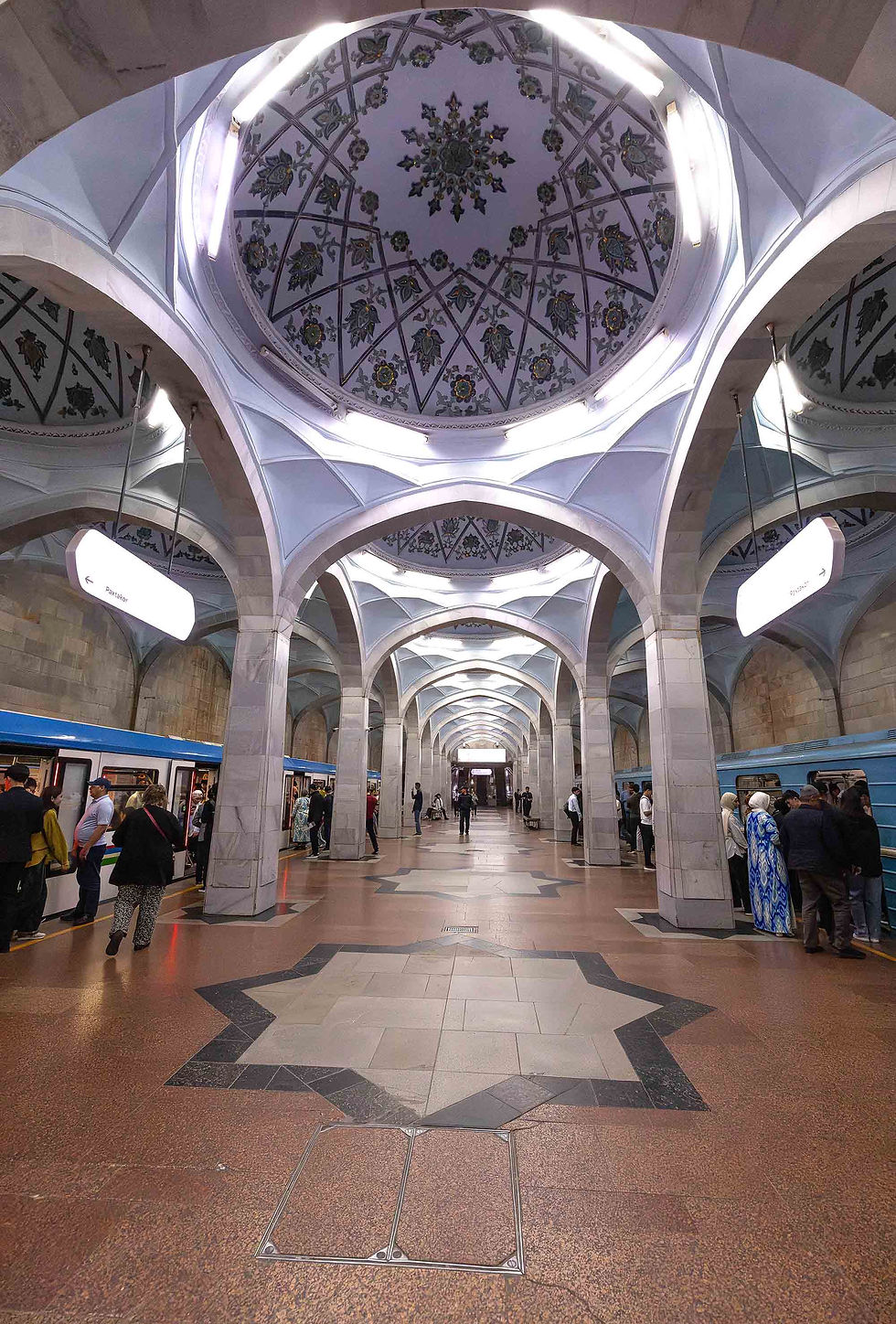
Marble columns, chandeliers, vaulted ceilings, decorative mosaics—you don’t feel like you’re in a metro station; rather, it feels as if you’re stepping into a palace or the lobby of a grand hotel. That was my first impression of the Tashkent Metro.
Each station is designed not as an ordinary transit stop but as a formal interior—polished stone underfoot, patterned walls, and lighting that reveals the design of the space.
Tashkent Metro Stations: Architecture Beneath the City

The Tashkent Metro was Central Asia’s first underground railway. Built during the Soviet period, when metros were reserved for cities with populations above 1 million, it came up following the rapid growth of the 1960s, and the first line opened in 1977. Like other Soviet systems, it was designed to withstand earthquakes and also function as a nuclear bomb shelter. Today, the metro operates from early morning until midnight.
Of the 38 stations—each with a distinct visual identity (no single standard layout across stations has been followed)—across four lines, I visited 12 stations.
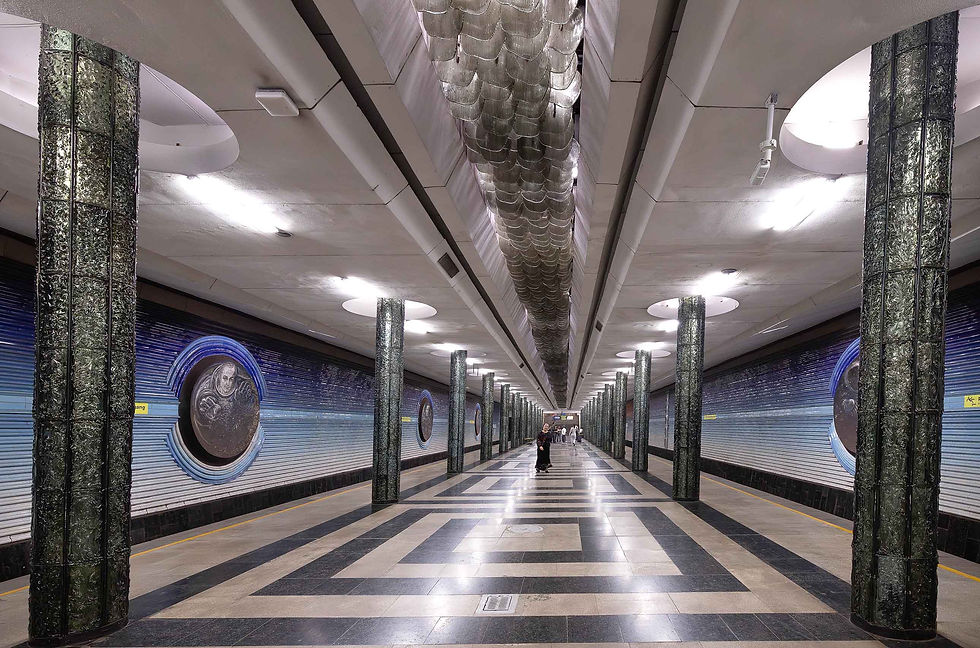
Kosmonavtlar Station features deep blue tones, ceramic medallions displaying portraits of famous Soviet cosmonauts (Yuri Gagarin, Valentina Tereshkova, and others), and a ceiling that evokes the Milky Way, and is a tribute to the Soviet space programme. Gradient walls transition from blue to black, suggesting movement through the atmosphere.
At Alisher Navoi, dedicated to the 15th-century Timurid poet and statesman Alisher Navoi, the design shifts towards Uzbekistan’s literary heritage. Blue domes with geometric patterns echo Silk Road mosques and madrasas, while ceramic murals on the walls depict scenes inspired by Novoi’s works.


At Pakhtakor the design draws on Uzbekistan’s cotton industry. Colourful mosaics of cotton flowers point to the central role of cotton in the country’s economy.

At Gafur Gulom, named after the renowned Uzbek writer Gafur Gulom, turquoise granite columns structure the space, creating a sense of rhythm across the platform, while ceramic panels on the walls add contrast and texture.

Mustaqillik Maydoni Station features robust columns made of marble from the Kyzylkum Desert (in Uzbekistan and Kazakhstan, Central Asia). Chandeliers across the length of the platform, arranged in symmetrical rows, augment the visual appeal of the station. Originally named after Lenin, the station was renamed after independence in 1991.

At Yunus Rajabi, called after the Uzbek musician and academician Yunus Rajabi, large marble pillars and a central staircase define the space, with minimal ornamentation, giving the station a restrained and open character.

Our next station was Abdulla Qodiriy, named after an influential Uzbek writer. Here, marble columns with coloured glass inlays and soft lighting from delicate chandeliers provide a balanced interior.

At Beruniy, the platform hall features a simple yet elegant white dome ceiling with marble patterns and crystal chandeliers, creating a classical interior. The station is named in honour of al-Biruni, a Persian scholar, scientist, and polymath.

Bodomzor Station, by contrast, combines geometric patterns with modern lighting, giving a more contemporary look. It sports cleaner lines and a lighter palette.

At Tinchlik, marble columns with integrated lighting cast a soft, even glow, and crystal chandeliers add a formal tone. Stained-glass panels running along the length of the walls introduce colour in an otherwise muted interior.

Farther along, at Xalqlar Do‘stligi Station, the design reflects Soviet ideals of power and strength through a more austere, yet monumental composition, with heavier columns and reduced ornamentation. (The name Xalqlar Do‘stligi means ‘Friendship of People’ in Uzbek.)

Tashkent Station features large blue-and-white ceramic murals depicting scenes of daily life reflecting the city’s long history as a cultural centre.


The architecture of Tashkent metro stations features distinct narratives—history, politics, culture, literature, science.
People at the Tashkent Metro
As the day progressed, my attention shifted to people.
When we boarded the metro the first time, a young passenger stood up and offered his seat to my wife, who had a leg injury. A simple act of kindness, I thought.
Then it happened again—this time towards our older friend and fellow traveller. And again. At all stations.
Different individuals. Different stations. The same thoughtful gesture each time.
No hesitation, no exchange of words, no visible calculation—someone stood up and vacated their seat.
After a few instances, the gesture no longer felt incidental. It was consistent.

Public Behaviour in Uzbekistan
At first, I read the act as good manners. But slowly I realized it was a social habit, not isolated acts of kindness.
As a South Indian, I am no stranger to showing respect for elders. What stood out here was the consistency of the behaviour in public space. In many cities, values that are practised within homes do not always extend to public places.

What the Tashkent Metro Experience Reveals About Uzbek Culture
What I saw in the metro began to make sense when I looked beyond that space. In Uzbekistan, social life is shaped by family networks and the mahalla—a neighbourhood system in which close community ties guide social behaviours. In this setting, values are not just taught; they are enacted. Which, over time, become instinctive and extend to public spaces such as the metro.
Uzbekistan’s Silk Road history also reinforces a tradition of hospitality.

Travel leaves impressions—buildings, monuments, landscapes. Rarely, it reveals patterns of behaviour that shape how a place is perceived.
I visited the Tashkent metro to observe the diverse architectural designs. And I left with a deep appreciation of the social etiquette shown by the local people. That stayed longer than any particular station.

Related posts:
The Silk Road Explained: History, Trade Routes, and Cities of Uzbekistan
Rishton Pottery: Uzbekistan's Ancient Blue Ceramics Along the Silk Road
Khiva, Uzbekistan: Itchan Kala, Silk Road Trade, and the City’s Hidden History
Chilpik Dakhma, in Uzbekistan: Zoroastrian Towers of Silence and Parsi Migration to India
Aydarkul Lake, Uzbekistan: A Desert Lake Born from Soviet Irrigation
The Story of Indian Coins: 2600 Years of Wealth, Power, Trade, and Culture
Bhutan Postage Stamps: How a Small Kingdom Revolutionized Global Philately
The Battle of Colachel: How a South Indian Kingdom Defeated the Dutch
My Son Sanctuary: The Cham Temples of Vietnam and Their Indian Connection
Armenian Church in Old Dhaka: History, Trade Networks, and the Legacy of Armanitola


Excellent article. Probably such beautiful metro stations reflecting art and culture of it’s people are found nowhere else. More like erstwhile royal palaces than railway stations. Look at our own railway stations about which less said is the better. New York’s grand central is nowhere near these works of art. Thanks for a wonderful article.
Such an elaborate travelogue giving glimpses into Soviet Mega Culture as well as their ethics. It’s surprising that such old stations are maintained as spanky as seen in pics over more than 50 years. Thanks for sharing
Thanks to you…i see the world…spectacular architecture and vision…also learnt about the culture…more strength and power to you!!
Beautifully written @devanandpaul. And the pictures spectacular! I felt transported to Tashkent itself and am hoping I would be able to see it for myself one day…and the insight about the people and their kindness and respect was next level! Thank you 🤩