
Birding in Dosdewa, Karimganj: A Hidden Birdwatching Destination in Assam
Updated: Jun 22
Birding in Dosdewa, Karimganj, Assam, combines forest trails, streamside bird hides, visits to the Hathikhira Tea Estate, and chance encounters of Siberian blue robin, white-tailed robin, Asian stubtail, Van Hasselt's sunbird, and Cachar bulbul.

Dosdewa forest, located in the southern corner of Assam near the borders of Bangladesh, Mizoram, and Tripura, is one of the least known birding destinations in Northeast India. This evergreen rainforest lies at the Khasi foot hills in Karimganj district and is extremely biodiverse.

This forest has seen little human disturbance and still retains much of its natural character. No luxury resorts, safari vehicles, or commercial developments. Dosdewa birding centres on forest trails, streamside hides, and nearby tea estates. Together, these habitats support a diverse mix of forest birds, making Dosdewa a notable birdwatching location in southern Assam. It was this rich birdlife that brought me and my friends Jamal and Latha to Dosdewa.

Birding Trails and Hides in Dosdewa
Morning birdwalks usually begin around 6:30 a.m. and continue until about 10:30 a.m. The trails lead through thick forest, where much of the birding depends on recognizing calls and locating birds concealed in the canopy, understorey, and undergrowth.

Afternoons, from 1:30 p.m. to 5:00 p.m., are generally spent at one of the four streamside hides. Although all hides attract many of the same species, each tends to favour a slightly different assemblage of birds. Reaching the hides involves wading through ankle-deep streams for 20 to 30 minutes.

Peak birding season generally falls from November to early March, when winter migrants visit and overall bird diversity increases.
Community-Based Birding in Dosdewa
Birding in Dosdewa owes much to Rejoice L. Gassah, a naturalist who grew up in the area. His knowledge of the local forests and birdlife shaped the birding trails and streamside hides that visitors frequent today. His brother, Jimison Gassah, and his team now manage the homestay and guide visiting birders in the field.

The homestay and guiding activities provide seasonal income for local families, as the birding season lasts only four or five months each year.
How to Reach Dosdewa
The most convenient gateways to Dosdewa are Guwahati, Silchar, and Badarpur. We took a train from Guwahati to Badarpur and flew back from Silchar. From Badarpur, Karimganj, or Silchar, Dosdewa is a 2–3-hour drive along rural roads.
Birding Along Dosdewa Forest Trails
Dosdewa forest trails are home to several forest birds, including many species associated with the Khasi foothills.
Among our early sightings was the scarlet-backed flowerpecker. Its diminutive size and constant movement in the canopy foliage meant it could easily be overlooked unless you searched the treetops carefully.

Another memorable sighting was Van Hasselt’s sunbird, typically associated with flowering trees and forest margins. It flitted between blossoms, probing flowers with its decurved bill and occasionally hovering before alighting on a nearby perch. Fleeting shafts of sunlight revealed the male’s iridescent pink-red throat, red belly, and glistening blue-green crown against its otherwise dark plumage.

We also heard the sharp, repetitive calls of the dark-necked tailorbird. It remained largely hidden within the dense understorey, occasionally emerging to forage among low shrubs and tangled growth.

The Cachar bulbul, a regional speciality, was usually spotted in the forest mid-storey. It moved methodically through the foliage, pausing to feed on fruits and arthropods (e.g., insects, spiders, crabs). Frequently, its calls betrayed its presence before the bird came into view.


The ruby-cheeked sunbird made a brief appearance amidst flowering plants. Black-headed bulbuls, in contrast, proved easier to observe; small parties moved noisily through the upper canopy.

The gold-crested myna, however, was absent during our visit; it is more commonly seen in November.
Birdwatching from Streamside Hides in Dosdewa
Most avian visitors here are secretive forest species. They emerge from the undergrowth to drink or bathe before slipping back into cover. And birding from these hides required careful observation. A flick of a tail, a rustling in the leaf litter, or a fleeting movement in the shadows often provided the first indication that a bird was approaching.
Among the more regular visitors was the orange-headed thrush, which foraged through damp leaf litter along the stream banks.

The black-breasted thrush was wary, frequently pausing to scan its surroundings before resuming its search for food. Yet it often remained in view longer than many other species.

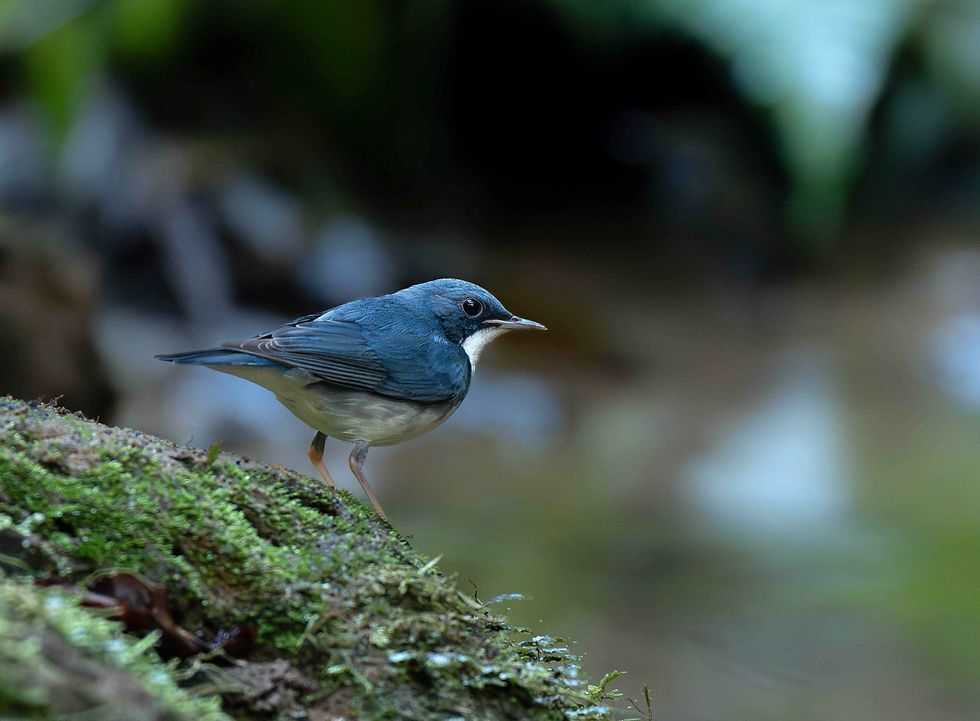
One of the most sought-after birds in Dosdewa was the Siberian blue robin, a winter migrant that breeds in Siberia and spends the non-breeding season across South and Southeast Asia. The male’s deep blue upperparts and snow-white belly contrasted strongly against the shaded understorey, making it one of the most visually distinctive species to visit the hides.
The white-tailed robin was bolder. We saw it pause on an exposed branch before dropping to the stream to bathe.

Overhanging branches above a rivulet attracted a succession of flycatchers: Hainan blue flycatchers frequently used low perches before descending to the stream and returning to the same vantage point. Pale-chinned flycatchers followed a similar behaviour but stayed deeper in the shade.


Snowy-browed flycatchers were highly active, shifting constantly between nearby perches, while little pied flycatchers and Taiga flycatchers foraged rapidly through the upper canopy. In contrast, the pale blue flycatcher kept largely to the shaded interior of the forest and rarely appeared in the more open vegetation near the stream.


Among the most colourful visitors were the niltavas. The rufous-bellied niltava stood out even in poor light. The small niltava was seen sporadically.


Some species preferred the lowest layer of the forest. The Asian stubtail darted through the leaf litter with mouse-like agility. Its tiny tail gives it an almost tailless appearance. The lesser shortwing favoured shaded stream banks, moving quietly among rocks and low vegetation. We detected the grey-bellied tesia by its high-pitched calls rather than by sight.


Black-crested bulbuls moved noisily through the canopy, while grey-headed canary-flycatchers repeatedly returned to their favoured perches between short sallies after insects.


Photographing birds from the hides in Dosdewa required patience and reflexive responses. Light filtering through the dense canopy created constant exposure challenges, and birds rarely stayed still long enough for an easy frame.
Birding at Hathikhira Tea Estate near Dosdewa
Hathikhira Tea Estate is one of the most productive birding locations near Dosdewa. In sharp contrast to the closed-canopy forests of Dosdewa, the tea estate is a mosaic of habitats—tea plantations, wetlands, and patches of woodland—within a relatively small area.
Soon after entering the estate, we spotted movement in the tall trees bordering the tea plantation: More than a dozen black bazas were perched in the canopy, some of which made short aerial sallies to capture insects before returning to the same branches.

In a wetter section of the estate, we spotted a ruddy-breasted crake moving cautiously along the edge of dense vegetation. Nearby, a lesser cuckoo sat quietly on a tall bush before slipping deeper into the foliage.

We saw a flock of blossom-headed parakeets perched on a tall tree and a Bengal bushlark walking through an open dried grassy area searching for insects. Along the muddy margins of a seasonal wetland, a pin-tailed snipe probed the soft ground with its long bill.

The morning concluded with the sighting of a fulvous-breasted woodpecker. We followed its drumming sound as it worked its way along a trunk, probing the bark for insects and larvae.

Why Dosdewa Is One of Assam’s Best Birding Destinations
For birders exploring Northeast India, particularly Assam, Dosdewa provides a very different birding experience from the region’s more established destinations. The combination of intact forests, excellent hides, and strong local community involvement has made it a rewarding birding destination in southern Assam.

Species Observed
Lesser Whistling-Duck
Cotton Pygmy-Goose
Red Collared-Dove
Spotted Dove
Asian Emerald Dove
Greater Coucal
Lesser Coucal
Green-billed Malkoha
Violet Cuckoo
Lesser Cuckoo
Himalayan Swiftlet
Ruddy-breasted Crake
Red-wattled Lapwing
Bronze-winged Jacana
Pin-tailed Snipe
Little Grebe
Asian Openbill
Little Cormorant
Black-headed Ibis
Little Egret
Indian Pond-Heron
Eastern Cattle-Egret
Black Baza
Crested Serpent-Eagle
Common Kingfisher
Blue-eared Kingfisher
Stork-billed Kingfisher
White-throated Kingfisher
Indochinese Roller
Blue-eared Barbet
Lineated Barbet
Blue-throated Barbet
Fulvous-breasted Woodpecker
Great Slaty Woodpecker
Rose-ringed Parakeet
Blossom-headed Parakeet
Red-breasted Parakeet
Black-winged Cuckooshrike
Black-naped Oriole
Black-hooded Oriole
Ashy Woodswallow
Black Drongo
Ashy Drongo
Lesser Racket-tailed Drongo
Hair-crested Drongo
Black-naped Monarch
Brown Shrike
Gray-backed Shrike
Rufous Treepie
Large-billed Crow
Gray-headed Canary-Flycatcher
Bengal Bushlark
Common Tailorbird
Dark-necked Tailorbird
Thick-billed Warbler
Striated Grassbird
Cachar Bulbul
Black-headed Bulbul
Black-crested Bulbul
Red-vented Bulbul
Yellow-browed Warbler
Green-crowned Warbler
Asian Stubtail
Gray-bellied Tesia
Puff-throated Babbler
Abbott's Babbler
Golden-crested Myna
Common Hill Myna
Indian Pied Starling
Chestnut-tailed Starling
Common Myna
Orange-headed Thrush
Black-breasted Thrush
Oriental Magpie-Robin
White-rumped Shama
Small Niltava
Rufous-bellied Niltava
Pale-chinned Flycatcher
Pale Blue Flycatcher
Blue-throated Flycatcher
Lesser Shortwing
Siberian Blue Robin
White-tailed Robin
Snowy-browed Flycatcher
Little Pied Flycatcher
Taiga Flycatcher
Siberian Stonechat
Pied Bushchat
Scarlet-backed Flowerpecker
Ruby-cheeked Sunbird
Purple-rumped Sunbird
Van Hasselt's Sunbird
Little Spiderhunter
Golden-fronted Leafbird
White-rumped Munia
Gray Wagtail
Tree Pipit


It seems like you’re a treasure hunter — finding hidden gems deep in nature and bring those little wonders back through your photographs. There’s something really beautiful about the patience and curiosity behind it.